7 Learning models to transform your training in 2026
Learning models key takeaways
- L&D is being reshaped by AI, skill gaps, and workforce agility concerns. Traditional training needs to be updated.
- However, proven learning principles like Merril’s Principles, and Bloom’s Taxonomy, still matter.
- Seven learning models that stand out in the AI era include: Learning in the flow of work, AI-powered and learner-centric training, collaborative learning, microlearning, immersive, hands-on learning, skill-based learning, and blended learning.
- The most successful learning strategies pair these models with platforms designed for modern learning, like Docebo.
Introduction
L&D has undergone some major shifts (AI being one of the biggest). So you’re not alone if you’re asking yourself what learning you should be offering to keep up with all this change.
But we’ve been here before. Moments like COVID pushed learning teams to rethink everything overnight. AI is no different. These are the times when you start reevaluating your learning strategy, your tech stack, and even your role in enabling the business.
But with new pressures, rising expectations, and more tools and models that you can count, it’s easy to feel overwhelmed.
So how do you figure out what’s right for your organization?
This blog breaks down seven learning models worth exploring right now. Keep reading to understand how each one works, and how they can help modernize your approach to learning, no matter your starting point.
New (and old) learning principles for the AI era
First, let’s look at some learning principles that will help your learners build new skills, reinforce existing skills, and engage more deeply with your learning programs. Some are tried-and-tested; others are brand new.
1. Merrill’s Instructional Design Principles
In the early 90s, David Merrill defined five principles that underpin engaging and transferable learning experiences. These five principles are:
● Task-centered, so learners are engaged in solving real-world problems
● Activated, so learners understand how to connect their new learning to their existing knowledge
● Demonstrated, with clear examples that show the desired learning outcome
● Applied, with opportunities to practice
● Integrated, so that learners can transfer their skills to new situations
Remembering these principles will provide a framework for whatever model(s) you decide to focus on.
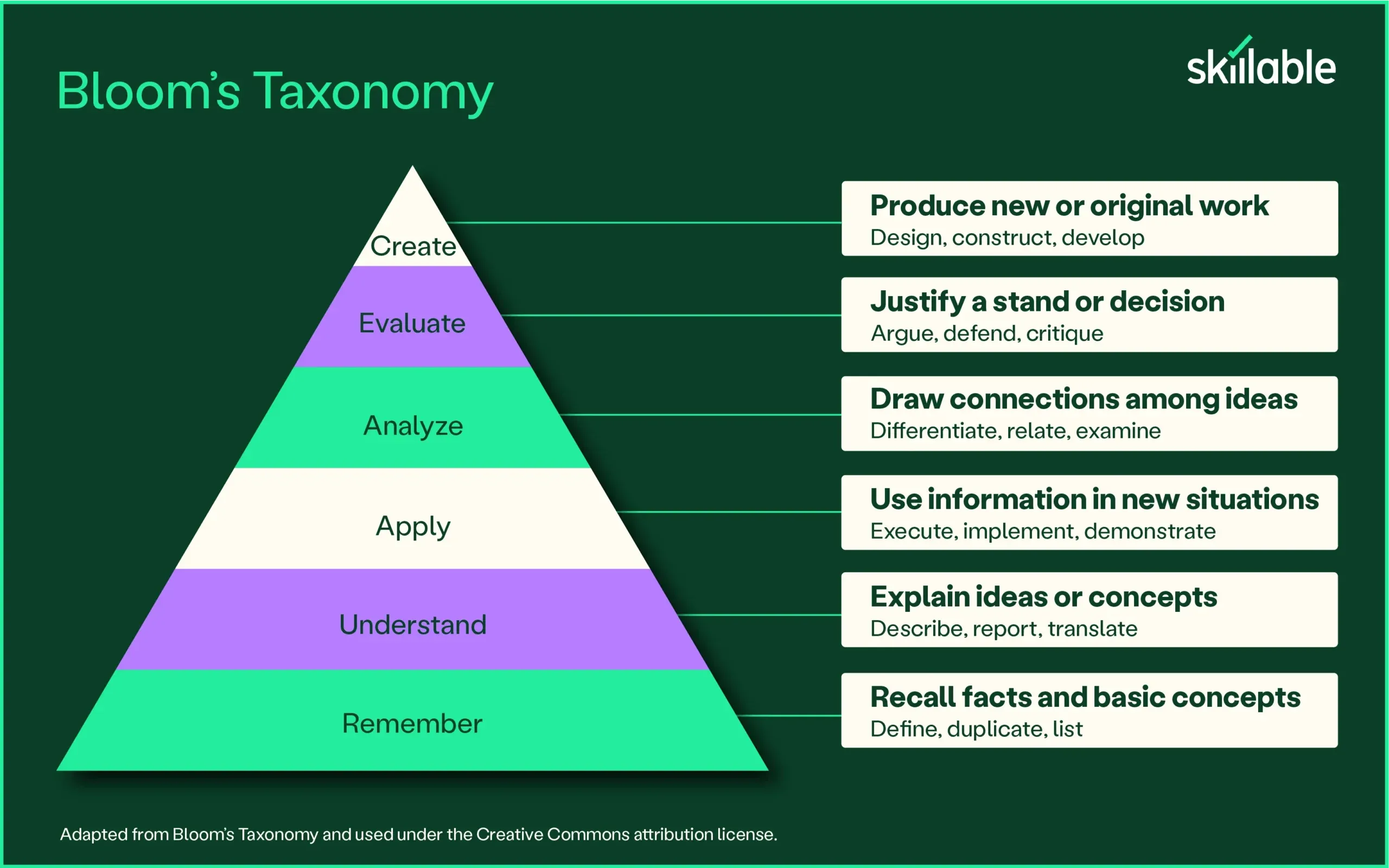
2. Bloom’s Taxonomy
Bloom’s Taxonomy helps instructors to organize learning objectives according to complexity, from psychomotor to cognitive. In the AI era, many AI agents are taking on the lower levels of the pyramid (Remember and Understand) which places greater emphasis on human workers to carry out higher-cognitive tasks such as analyzing, evaluating, and creating. This shift in activities needs to be reflected in the learning and practice environments provided to learners.
3. Challenge-centric learning
Author and educator John Holt once said, “Learning is not the product of teaching. Learning is the product of the activity of learners.” Challenge-centric learning is a methodology that uses activity-based assessments and performance testing to understand if someone’s skills have reached the necessary level for their work tasks, and if they can apply them in the moment of need with confidence.
It can also be used to develop greater proficiency. By challenging someone repeatedly to use their skills in different situations, they build muscle-memory and faster recall. It is especially useful in high-pressure situations such as defending against a cyber-attack or responding to a stressed customer’s complaints.
4. 70-20-10 and learning sprints
You’ve probably heard of the 70-20-10 model of learning (70% being experiential, 20% being social, and 10% being formal learning). But are you familiar with learning sprints?
Gartner takes the 70-20-10 model a step further with a sprint framework that takes a specific outcome-based learning objective (think: building generative AI prompt engineering skills) and then designs a mix of learning experiences that match both the ratio and the outcome.
In real life, this ends up looking like a blended learning approach: on-the-job practice, content libraries, virtual IT labs, peer communities, mentoring, and some classroom-style learning sprinkled in. It’s the combination that matters, not the format.

Now that we’ve revisited the learning principles you could apply to the AI era, let’s go over the 7 learning models you might consider implementing into your 2026 learning programs.
7 learning models to consider in your 2026 tactics
Here are seven learning models that are particularly relevant to the opportunities and challenges of today.
1. Learning in the flow of work
2. AI-powered and learner-centric
3. Collaborative learning
4. Microlearning
5. Immersive, hands-on learning
6. Skill-based learning
7. Blended and hybrid learning
1. Learning in the flow of work
You’ve probably heard of the phrase “learning in the flow of work,” but it’s becoming less of a trend and more of a necessity. Most employees feel time-crunched, and the idea of stepping away for long, formal training sessions just doesn’t fit how work happens anymore. Learning in the flow of work solves that by giving people quick, relevant guidance right when they need it (while they’re already doing their jobs).
This usually includes microlearning or lightweight resources delivered through accessible online tools. But they can also be delivered through learning platforms like Docebo. With Docebo Companion, for example, learning doesn’t live off to the side in your LMS. It shows up directly inside the tools and browsers your employees use every day—Salesforce, Jira, your knowledge systems, or anywhere work happens.
Instead of going out of their way to find training, employees get the right support at the exact moment they need it, without breaking their workflow..
2. AI-powered and learner centric
DId you know that 79% of organizations are using AI in their learning strategies with 65% using it for content creation? In the AI-powered, learner-centric model, individuals can generate learning content and environments on-the-fly using AI. And speaking of, AI can then surface the content based on their past performance and assessed skill level, which further personalizes the experience. Now, that’s neat.
AI-driven personalization ensures that learners fully grasp each concept before moving on, resulting in stronger foundational skills.
What would this look like? Well, let’s take a data visualizer as an example. They want to practice their skills. So what if they had an environment that allowed them to build dashboards and infographics, with AI generating instructions or assessments based on their prompts on what they wished to practice?
The same kind of environment could be repurposed for a marketing manager with a more basic need for data visualization.The AI tool would generate a practice session that teaches them how to build a report for senior leadership on a recent campaign. AI can also be used to visually assess and score each learner, allowing for more nuanced evaluations (e.g., has the learner created a dashboard in the right brand colors and using a coherent, relevant heading?).
Tools like Skillable allow for this kind of immersive learning experience, while learning platforms like Docebo’s include AI virtual coaches that empower learners to practice their skills with AI coaches. If you thought that would be great for sales enablement to practice an elevator pitch, you’re onto something!
3. Collaborative learning
Humans are social creatures, so having an element of collaborative and community learning in your program can help them share their knowledge and experiences while reinforcing their skills. As the 70-20-10 framework highlights, 20% of learning comes from interactions with colleagues and others. You can introduce collaboration into your learning experiences in several ways, including:
1. Peer-learning groups where learners can practice their skills with peers and get advice. These can be in-person or online.
2. Mentoring and coaching, including reverse, where younger employees may mentor and coach older generations in new work practices and tools.
3. Challenges such as capture-the-flag activities for cyber-skills.
4. Informal lunch-and-learns or other activities where employees can share new skills with colleagues in a low-pressure setting.
5. Crowdsourced resources, such as internal wikis, can help people retain and share institutional knowledge.
4. Microlearning
Time-poor employees love microlearning, where training is broken up into short, focused learning modules that feel more manageable in the flow of work and can increase knowledge retention by up to 70%. The key is keeping it short, something that someone can consume or practice in under an hour, and in building the skill over the course of several modules instead of all in one go.
Learning platforms like Docebo allow you to generate microlearning content quickly using AI, and also offer microlearning resources through their content marketplace.
5. Immersive and hands-on learning
With hands-on training, instead of watching someone else perform a task, learners can do it themselves in a live immersive environment. It is an active learning model that has applications across customer training, upskilling and reskilling, technical sales and partner enablement, and more. Skillable’s Virtual IT labs are a form of hands-on training that are applicable to technical skills and software or hardware adoption. In these non-production (aka, safe and controlled) environments, learners click on real buttons, configure real settings, and create real outcomes. It makes theory real and relevant.
6. Skill-based learning
More organizations are shifting toward a skill-based model for hiring, talent management, and upskilling. Skill-based learning is an extension of this, using skill data to recommend learning resources that meet learners where they are, at their level and pace. Gartner also recommends that skill data is used to understand the moments when an employee needs to build a skill, allowing organizations to tailor just-in-time and “in the flow of work” training to that exact moment. Of course, for skill-based learning to be accurate and effective, the foundation of skill data it’s built on needs to be high quality, performance-based, validated, and timely.
7. Blended and hybrid learning
Throughout this piece you’ve likely seen how interwoven some of these learning models can be. There isn’t going to be a single learning model that you’ll use to train your people. It will be a hybrid. You may also use online and in-person learning together, known as blended learning.
Focusing on the skill being trained is critical to choosing the best mix of learning models. For programming, you may use a learning pathway or classroom-based session at the start and then a virtual lab to practice and reinforce that learning. For leadership skills, you may use peer groups more heavily and enable practice through on-the-job assignments.
Make learning happen
These learning models are not all new, but they work. And they’re surprisingly easy to adapt to the AI era. As you think about which ones fit your learners and your business, keep coming back to one question: What tools and processes will actually prepare people to perform better?
The most effective learning models don’t chase trends. They evolve with the times while sticking to what’s proven to help people learn, practice, and grow. And a lot of that impact depends on having the right platform behind you.
That’s where a learning platform like Docebo can make all the difference. Take Disguise, for example. When they introduced microlearning through Docebo, their active learners increased four-fold, simply because the format and the platform made learning easier to access and easier to sustain.
If you’re exploring these models, pairing with a platform built for modern learning is the key to bringing them to life. See why over 3,800 organizations around the world trust Docebo to deliver their learning programs. Book a demo today.
Learning models FAQs
1. What are the most effective learning models for corporate training?
The seven learning models we discussed in this article are definitely a great fit for corporate training. That being said, the right mix depends on your goals, your learners, and the tools you use to deliver training.
2. How do I choose the right learning model for my organization?
Start by defining the skills your workforce needs, the pressures you’re facing (AI, agility, reskilling), and the environments where learning will happen. Then consider which models best support those needs. A learning platform like Docebo makes it easier to test and combine models without overhauling your entire strategy.
3. How can immersive, hands-on learning improve performance?
Hands-on learning allows people to practice new skills. It builds confidence faster than theory alone. Tools like Skillable virtual labs, simulations, and Docebo’s AI virtual coach support this model well.
4. How can a learning platform like Docebo support all seven learning models?
Docebo centralizes learning content, personalizes it with AI, and offers flexible learning formats like microlearning, while giving learners the opportunity to practice their skills. The platform also comes built with collaborative and social learning features, and robust data tracking for skills, in addition to letting you learn in the flow of work. It’s designed to help you apply these models without stitching together multiple tools.