The half life of a career is short and getting shorter
Wanted: 5 years’ experience
Five years of experience is a gold standard of mid-level hiring: A proxy for competence, a safety net for recruiters, and a benchmark for career progression.
Not anymore.
We’re currently operating in a BANI environment: Brittle, Anxious, Nonlinear, and Incomprehensible. What you knew yesterday has never mattered less. Research shows that the half-life of new tech skills has dropped to as low as 2.5 years.
Think about that. If you stop learning today, half of your technical value evaporates by the time you’re due for your next promotion.
The myth of stability
Today, most organizations still think in terms of “jobs:” Discrete roles and lists of responsibilities. This assumes a stable environment, where the work that needs to get done stays (mostly) constant.
That’s great. But the work of today isn’t stable.
Skills-based thinking embraces this instability. It assumes evolution, adaptation, and constant change.
The perfect example is Prompt Engineering. In 2023, prompt engineering was hailed as the “job of the future,” with salaries reaching $335,000+. Two years later, it was already obsolete as a standalone role.
The importance of prompt engineering didn’t exactly disappear. But it became a baseline capability for everyone from marketing to product development. The job disappeared. The skill is critical.
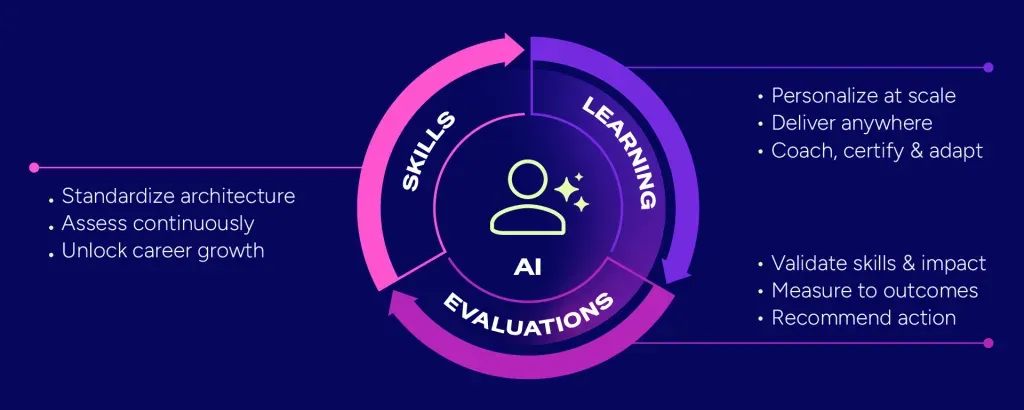
Real workforce readiness comes from learning, skills, and constant evaluation.
The $18,000,000,000,000 wake-up call
More than an HR headache, this is a global economic crisis. Workforce readiness gaps have cost the world economy up to $18 trillion in unrealized GDP to date.
Despite this, only 27% of companies are actually building the skills they need to evolve. Most are still “drowning in tools” and HR platforms that provide lots of data but zero transformation.
Finding a way forward
To survive the 2.5-year half-life, we have to stop treating skill gaps as holes to be filled and start treating them as signals to be decoded. Workforce readiness doesn’t come from more hiring. It comes from Skills Intelligence; using AI to infer skills from actual work, performance, and behavior in real-time.
Our latest report can help you bridge the skills gap and build real workforce readiness, sustainably.
Download the report HERE.