From Skills Insight to Skills Execution: Why Docebo Acquired 365Talents
Read below for my take on the acquisition and what it means going forward. If you’d rather hear it directly, join me and Loïc Michel, CEO of 365Talents, for a live discussion on what’s next on February 19.
Over the last year, one topic has kept coming up in my conversations with customers: skills.
And not even in a theoretical way. In a super frustrating way.
For years, skills have been positioned as the answer to workforce transformation. Skills as a currency. Skills-based organizations. Skills frameworks as the foundation for learning, mobility, and workforce planning.
On paper, it all makes sense. In practice, many leaders feel stuck.
And that frustration is exactly why Docebo has acquired 365Talents, a leader in AI-first skills intelligence.
This decision wasn’t about chasing a trend. It was about fixing a problem we see everywhere: the growing gap between skills, learning, and business execution.
When Skills Stop Moving
The most frustrated leaders I talk to are not beginners. They’re organizations that have already invested.
They built skills frameworks inside large HR systems. They spent months defining taxonomies, mapping roles, tagging content, and running workshops.
And then… nothing really changed.
That’s because building a skills and job architecture in the pre-agent era was hard, slow, and expensive. It was heavily consulting-driven, required months of manual effort, and was often out of date by the time it launched.
Then the business changed.
A reorg. A merger. A new strategy.
Suddenly, all that investment had to be revisited, remapped, or rebuilt, adding stress on top of work that already felt fragile.
What organizations are left with is a box. A big, expensive box of skills data that looks impressive in a deck but doesn’t move the business forward. The skills get old. The reports pile up. And when it’s time to justify the investment, leaders can’t point to outcomes that actually matter.
That gap, between ambition and execution, is the real problem across the market.
The Problem Isn’t Skills
Most skills initiatives fail for the same reason: skills have been treated as the outcome, not the input.
Organizations define, assess, and store skills as if checking the box is the goal. But skills on their own don’t create impact. They are preparation.
Impact only shows up in execution. It’s the ability to apply skills in real situations, repeatedly, and under pressure. Completion can be tracked. Proficiency can be claimed. But capability isn’t proven until behavior changes and performance improves.
When skills are treated as static outputs instead of signals that should drive action and validation, they fall short of what the business actually needs.
That’s what happens when skills are disconnected from how work actually happens. They lose value fast.
- They turn into reports instead of decisions.
- Dashboards instead of action.
- Metadata instead of momentum.
So it’s no surprise the industry started pushing back.
I’ve read plenty of critiques arguing that skills-based organizations are unrealistic, overly complex, or even a distraction. Some people I respect deeply have made those arguments. And I don’t blame them. When skills become an academic exercise, skepticism is earned.
But I challenge that conclusion.
Complexity doesn’t make skills irrelevant. It exposes that we’ve been framing the problem incorrectly. When skills feel unusable, it’s not because they lack value. It’s because they’ve been treated as an end state instead of a means to drive real outcomes.
Given the pace of change, an aging workforce, and the way AI is reshaping roles, not thinking in skills would be reckless.
What Actually Matters to a CEO
Skills only matter when they change behavior.
As a CEO, I don’t care if a team “has skills.” I care whether capability improves in ways the business can feel. If 100 service reps move from level one to level three on a skills framework, that doesn’t get my attention.
What does get my attention is impact.
- Are customers more satisfied?
- Did engagement scores improve?
- Is quality higher?
- Are we reducing rework, risk, or escalations?
The same applies across the business. If my engineering organization invests in upskilling, I don’t want a skills heat map. I want to know whether teams are delivering faster, whether quality is improving, and whether people can take on more complex work than they could six months ago.
That’s the bar.
Why We Acted—and Why 365Talents
When we stepped back and looked at this problem, we didn’t ask ourselves, “How do we add skills?”
The harder question was this: why do so many well-intentioned skills initiatives stall after year one?
We asked that question knowing we weren’t immune. Years ago, we launched our own skills initiative at Docebo. It was well intentioned, thoughtfully designed, and it stalled within months. That experience forced us to confront the gap between seeing skills and actually being able to operate on them.
The answer was obvious.
Very few organizations can operate on skills at scale, across learning, mobility, and workforce decisions. What’s missing isn’t more data. It’s a system that turns skills into execution.
- A system that keeps skills current as work evolves.
- Connects skills directly to learning execution, not just content tagging.
- Validates real capability, not just participation.
- Feeds decisions about readiness, staffing, and internal mobility.
Solving that meant going beyond skills as a static layer and treating them as a continuously evolving system. It also meant being honest with ourselves. This wasn’t something we could build responsibly on our own.
That’s why we chose to bring 365Talents into Docebo.
We weren’t looking for a legacy skills platform or another taxonomy-heavy system. We chose 365Talents because they are fundamentally technology-driven. Their platform uses sophisticated AI agents to do in minutes what used to take senior consultants months: creating and maintaining a skills and job architecture that actually reflects how work changes.
That architecture can then be refined by internal teams or consulting partners, instead of becoming brittle the moment the business shifts.
And this is just the starting point. Together, we’re building additional agents designed to make skills truly operable across learning, readiness, and workforce decisions.
Why Execution Is Now the Constraint
The pace of change isn’t slowing down. It’s compounding.
Yet most organizations are still trying to manage this reality with static frameworks, periodic reviews, and disconnected tools.
That gap creates real risk.
Teams fall behind faster. Readiness is assumed instead of proven. And workforce investments become harder to justify as pressure increases.
The old model, define skills, deliver training, hope it connects, can’t keep up.
What’s required now is a system that treats skills as a living signal. Detecting change as it happens. Acting on it quickly. Continuously validating whether capability has actually improved.
Not once a year. Not in a slide deck. In the flow of work.
Turning Skills Into Something the Business Can Rely On
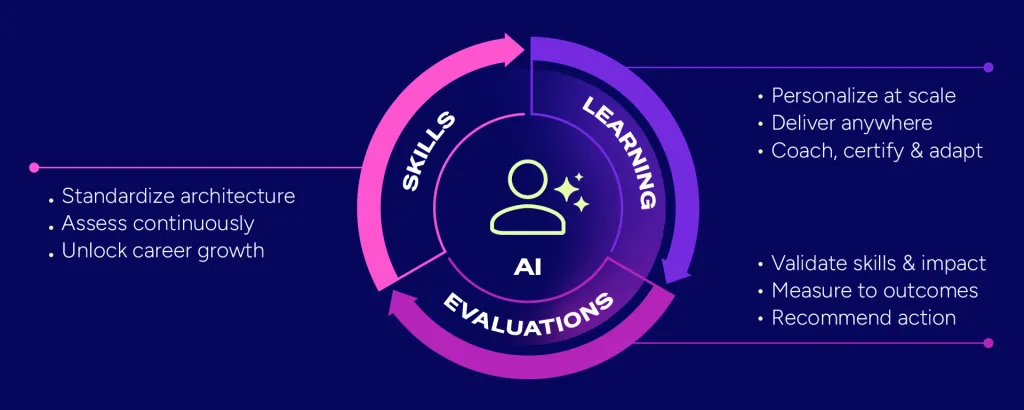
This acquisition is a step toward that standard.
Not because skills are a new idea, but because it’s time to stop managing them in isolation and start operating on them as part of how work gets done.
By bringing together skills intelligence and learning execution, we’re building a system where insight leads to action, action leads to capability, and capability shows up in real business outcomes.
AI does the heavy lifting in the background, keeping skills current, activating the right learning and workforce actions, and validating progress over time, so execution doesn’t depend on manual effort or constant coordination.
That’s the direction we’re committing to.