Why we refreshed the Docebo brand
There’s a familiar story that gets told whenever a new CMO joins a company and a rebrand follows shortly after. I’m aware of it. I probably fit the mold well enough to make people overly suspicious. Sorry, not sorry.
I get it, but the truth is much simpler and less dramatic. Bummer.
I joined Docebo in April, and the instinct to revisit the brand surfaced quickly, not because I wanted to put a personal stamp on the company, but because the gap between who we are and how we appeared in the market had become impossible to ignore.
Learning, talent development, LXP, LMS, skills intelligence, workforce intelligence (blah blah blah). These are crowded categories. Walk a tradeshow floor, and the mind-numbing effect is immediate. Booths blur together, and messaging overlaps. Everyone sounds confident, and everyone is a damn leader. We all have an opinion, but the opinion is the same.
Unfortunately, Docebo was part of that picture.
That didn’t mean the brand had failed. It was just tired and no longer reflected the role we play today, or the role learning plays in a world shaped by rapid technological change.
The reality is pretty simple. Work is changing quickly.
It might be simple, but it’s not gradual or predictable. The pace of change has outgrown the systems most organizations rely on to manage their people and capability. This isn’t about preparing for some distant future state. Many organizations are already feeling the strain.
The shift is real and meaningful. Tools that once felt advanced are now widely available, reaching organizations of every size. As access expands, differentiation moves elsewhere. Progress depends less on technology itself and more on whether people can actually apply it in real work, under real conditions.
Adoption matters. Application matters. Adaptation matters.
And the best part? Learning sits at the center of that capability.
This has always been part of Docebo’s DNA. What changed is the urgency. Expectations inside organizations are higher. The cost of standing still is clearer. And most of the systems designed to support people were built to document work, not adapt as work keeps changing.
When systems stay static, people feel it first.
Our brand needed to express that reality with more damn confidence and clarity.
Enter the manifesto.
Before any visual work began, we focused on belief.
We wrote a manifesto, not as a marketing ploy or tactic, but as a way to articulate what we genuinely believe about this moment. Writing it forced precision about the limits of AI on its own. Continuous learning is a requirement rather than an aspiration, because readiness can’t be deferred when work is changing in real time.
It’s about the distance that often exists between knowing something and acting on it.
That document, and the video that followed, became a reference point. Every decision was tested against it. If something didn’t align, it was reconsidered.
From that process came a line that felt honest and a little inspirational. We are marketers. We love a little inspiration.
Never Stop Learning.
It isn’t meant to be clever. It reflects a simple truth about how progress happens when change is constant. Learning is how capability stays visible, current, and useful, not just recorded somewhere after the fact.
And the visual identity shifted from the same thinking.
Docebo has history. Italian roots. A legacy of building serious technology for complex, large organizations. We wanted to carry that forward while introducing a new energy.
The creative direction that emerged plays with tension. Classical forms alongside modern color. Structure paired with movement. Elements that feel established, placed next to ones that feel alive and evolving.
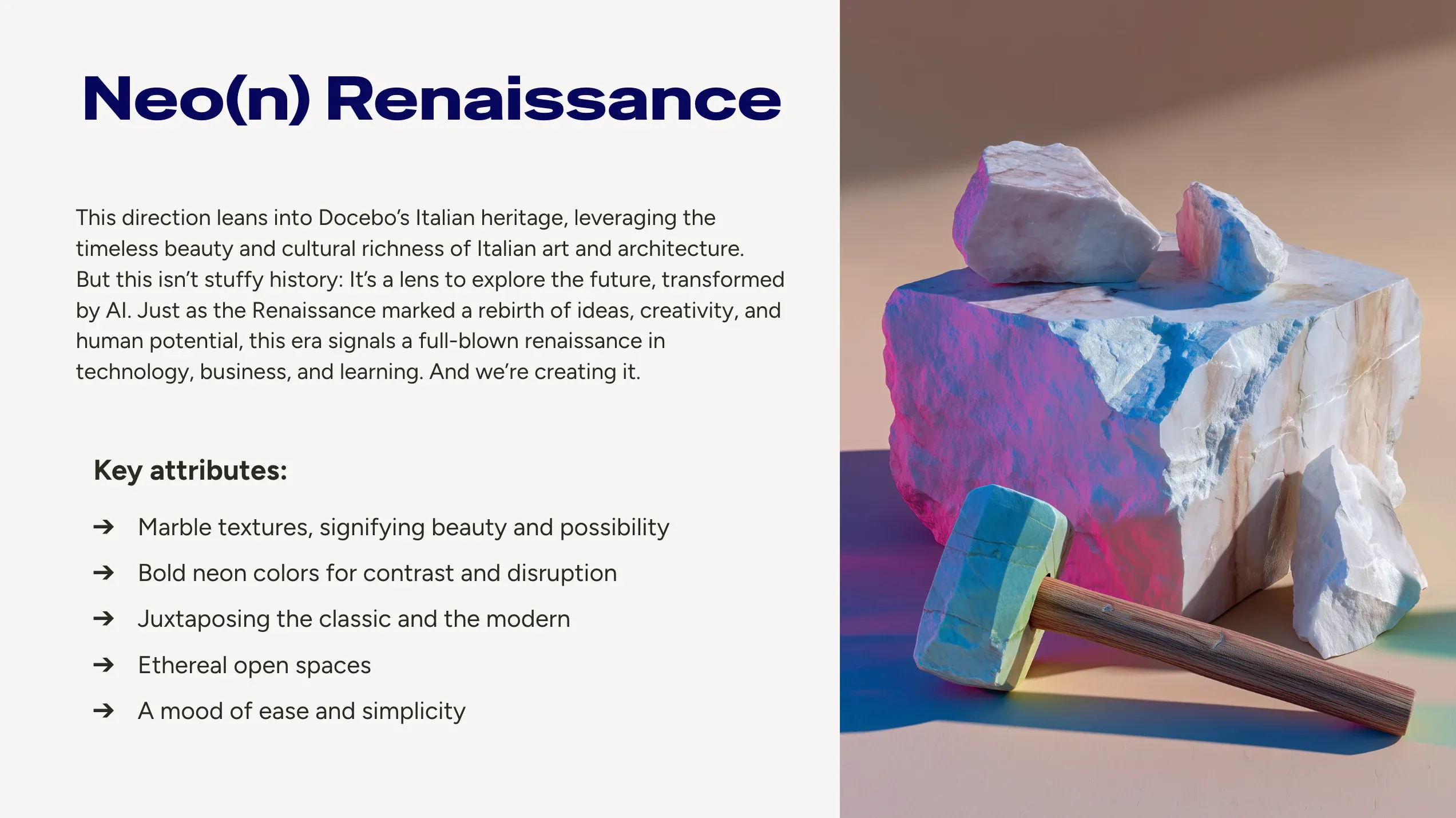
Internally, we refer to this direction as Neo(n) Renaissance. The Renaissance marked periods where new tools expanded human potential rather than diminishing it. The parallel felt relevant. Technology continues to move quickly, but progress still depends on people learning how to use it well.
The goal was never trend-chasing. We focused on building a system capable of scaling across products, regions, and experiences while remaining recognizable.
We kept it internal (mostly).
One of the decisions I feel most strongly about is where this work lived.
Nearly all of this refresh was developed internally. Designers, marketers, customers, product teams, and leadership worked closely throughout the process. That proximity matters. It keeps the work grounded in reality and we all know siloed marketing teams are not grounded in reality.
More importantly, it creates shared ownership. A brand only works when the people behind it understand it, believe in it, and feel connected to it.
And last but not least, we have a damn opinion.
The most important changes extend beyond appearance. Tone and voice are evolving. Docebo is becoming more direct and more comfortable expressing a point of view. The brand relies less on category language and more on clarity about what we believe learning enables.
Learning is treated as foundational infrastructure for organizations operating in a constantly changing environment. When learning, skills, and evaluation aren’t connected, organizations lose visibility into readiness, and people lose momentum. That’s not a messaging problem. It’s a systems problem.
We will be rolling out the new brand throughout this year, but what remains consistent is the idea that has guided Docebo from the start.
In periods of rapid change, progress belongs to people who keep learning.
The future belongs to the learners, and to the organizations that treat learning as a living system rather than a static function.
We’re building for that reality. Never stop learning,
Kyle