LMS vs LXP: Which One is Right for Your Business in 2026
Many organizations spend months debating between a learning management system and a learning experience platform (LXP)—only to find themselves stuck between outdated functionality and fragmented experiences. The reality? Neither platform alone addresses the full scope of enterprise learning needs, especially as many organizations see a skills crisis, with 49% of L&D professionals reporting that their executives are concerned employees lack the skills to execute business strategy.
Some try combining both, but this often creates silos and disjointed learning journeys. This article will guide you through the fundamentals of LMS and LXP platforms, their key differences, and when each makes sense for your organization.
You’ll also discover why AI-driven learning platforms are emerging as the next evolution—combining the best of both worlds while solving their limitations. Let’s start with the basics.
What is a learning management system (LMS)?
An LMS is a software platform that allows organizations to create, deliver, manage, and track employee training programs, including e-learning, microlearning, and compliance training.
The administrator creates specific learning content to lead learners through a training program with a particular goal in mind. For example, a company may use an LMS to create an onboarding process that contains all the training new employees need to succeed.
It can be used to implement employee learning and development courses as well, which is critical for organizations, as 55% report being unable to measure learning’s impact on business performance.
A business may also use an LMS to teach customers how to effectively use their products, but most LMSs are not ideally suited to tackle multiple audiences.
Key LMS features
While each LMS is unique, most platforms share these common features:
- Responsive, user-friendly design: Most LMSs will have a responsive design that works seamlessly across all devices. They also tend to have a user-friendly UI to make learning effortless.
- Analysis and Reporting tools: It’s common to find tools to help assess the learning program’s effectiveness. You can see how individual learners and groups of learners are performing and make any necessary changes or improvements in response to the data.
- Course management: This allows administrators to create and catalog the content they want in their digital learning programs.
- Help features: There may be features designed to help learners who get stuck. This can include discussion forums or access to a support representative.
- Certification and compliance: Many businesses use their LMS for compliance training to ensure everyone knows the requirements. They can also be used to certify employees to perform certain tasks.
- Automation: Some features may allow repetitive tasks to be automated to save time.
- Some LMSs can also include gamification, social learning, and AI capabilities but these are usually limited compared to AI-driven learning platforms.
What is a learning experience platform (LXP)?
An LXP is a learner-centric platform that provides personalized, self-directed learning experiences through AI-powered content recommendations, similar to how Netflix suggests shows. Unlike traditional LMSs, LXPs focus on user-generated content, social learning, and discovery rather than administrator-assigned training paths.
They allow for the creation, curation, and use of different kinds of content, including internal training content, external content like blogs and industry research, and even user-generated content to allow learners to share what they know with each other. If a user wants to learn something that the company doesn’t have a dedicated learning path for, they can use the LXP’s AI features to curate the content they need.
This kind of informal learning pathway allows employees to take the initiative and engage in skill development on their own, and research shows that AI-powered learning tools can lead to users spending significantly more time on autonomous learning daily.
Key LXP features
Most LXPs include these distinguishing features:
- User-generated content: Users can create their own content, including individual posts to provide information they believe others may find helpful or entire courses to teach a concept from start to finish.
- Content curation: LXPs use AI and machine learning (ML) to curate content for users on topics of interest. Users can also curate internal and external content into lessons that they can share with other users.
- AI recommendations and training: AI may be used in some LXPs to make content recommendations, sometimes through the use of chatbots. It may also have the ability to ingest and understand the learning materials and create microlearning training materials to allow users to learn the most important parts in small, digestible lessons. It can use articles, webinars, podcasts, and more to create a new learning journey or to recommend a place in the content to begin watching or listening based on the topic they want to learn about.
- Analytics: Analytics can display dashboards to users, showing their progress. Administrators can also use them to view learner progress and understand what professional development users are engaging in. But tracking and reporting capabilities may be limited for use cases like compliance.
- Gamification: Leaderboards, achievements, and other gaming features can improve learner engagement, much like how AI interventions have been shown to have stimulated students’ proactive thinking and increased classroom interaction by 117%.
- Integrations: You may be able to connect your LXP to an external learning platform like LinkedIn Learning or Coursera to give users access to courses from third-party providers. You can also find integrations for your other business software solutions, like your customer relationship management platform (CRM), or other tools you use, like communication apps.
LMS vs LXP: What’s the difference?
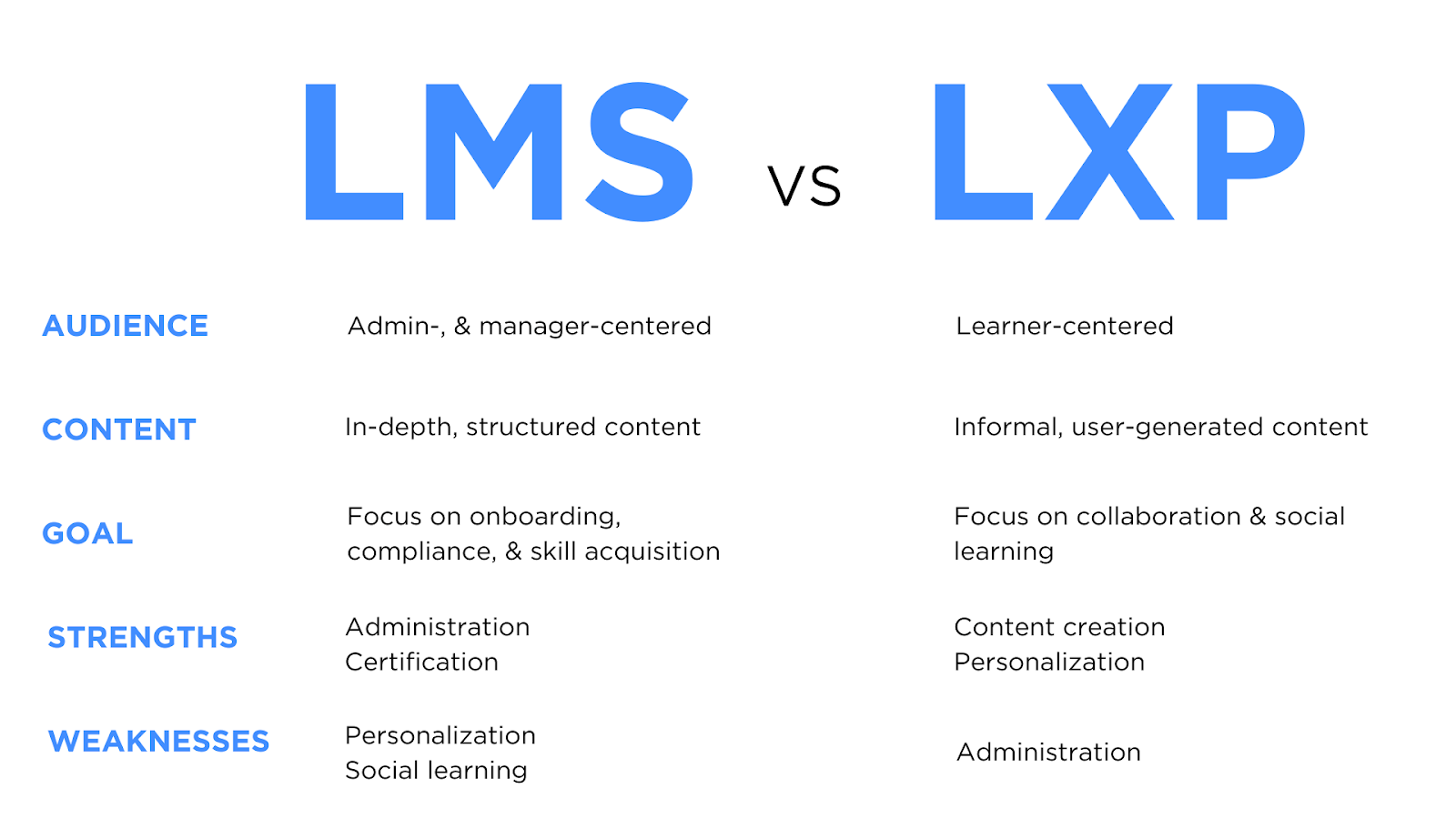
While both platforms support employee training, their approaches differ fundamentally:
| Feature | LMS | LXP |
|---|---|---|
| Learning approach | Administrator-led, structured paths | Learner-driven, self-directed |
| Content creation | Admin-authored only | Admin and user-generated |
| Best for | Compliance, onboarding, formal training | Continuous learning, skill development |
| Control | High administrative control | High learner autonomy |
LMSs excel at formal learning with specific outcomes, while LXPs create engaging environments for continuous skill development.
LMS vs LXP pros and cons
While LMSs and LXPs are both types of learning technology, some key differences make each unique. Both options provide a learning ecosystem for employee and/or customer training, and both can have social media and gamification features to improve employee engagement and retention.
However, there’s a different approach to learning in an LMS vs. LXP. LMS platforms focus on allowing L&D teams to create lessons and courses to guide users through a specific learning path to a specific end.
LXPs, on the other hand, focus on user-directed learning to allow employees to choose what they want to learn. While LMSs allow admin authoring of course material, LXPs also allow users to create course content.
They both provide assessments to help you understand the efficacy of your learning programs and features made to aid with the flow of work. LMSs work for more formal learning, while LXPs offer a more casual and self-directed method.
Each platform has distinct strengths and limitations:
LMS advantages:
- Strong administrative control and structured learning paths
- Robust compliance tracking and certification management
- Comprehensive reporting for audits and regulatory requirements
- Proven track record for formal training programs
- Clear course completion and assessment capabilities
LMS limitations:
- Can feel rigid and less engaging for learners
- Limited personalization in traditional systems
- Often lacks social learning features
- May not support self-directed learning well
- User experience often prioritizes admin needs over learner needs
LXP advantages:
- Highly engaging, learner-centric experience
- Strong personalization through AI recommendations
- Encourages continuous learning and skill development, and studies show that the self-directed learning behaviors fostered by these platforms have positive correlations with academic performance.
- Supports user-generated content and knowledge sharing
- Intuitive interface that feels familiar to learners
LXP limitations:
- Weaker compliance tracking and reporting
- Less administrative control over learning paths
- May lack structure for mandatory training
- Can be challenging to measure formal learning outcomes
- Not ideal as a standalone solution for regulated industries
When to choose an LMS vs LXP for your organization
The right choice depends on your organization’s specific needs, learning culture, and business objectives.
Choose an LMS when you need:
- Strong compliance and certification tracking
- Structured onboarding programs with clear milestones
- Detailed audit trails for regulatory requirements
- Administrator-led training with specific learning outcomes
- Comprehensive reporting tied to business metrics
LMSs excel when precision, structure, and administrative control are your top priorities.
Choose an LXP when you want to:
- Foster a culture of continuous, self-directed learning
- Encourage knowledge sharing across your organization
- Provide personalized learning recommendations
- Support informal skill development beyond formal training
- Create an engaging, social learning environment
LXPs work best when learner engagement and continuous skill development are your primary goals.
But here’s the thing: you shouldn’t have to choose between structure and engagement, between compliance and personalization. That’s where AI-driven learning platforms come in.
What is an AI-driven learning platform?
An AI-driven learning platform combines LMS and LXP functionalities into a single system, using artificial intelligence to automate administration, personalize learning paths, and deliver engaging experiences. Key features include:
- Intuitive, user-friendly design
- Advanced Analysis and Reporting tools that tie learning to business metrics
- Course management
- Help features
- Certification and compliance
- Social learning that fosters collaboration and knowledge sharing to strengthen institutional knowledge
- Gamification
- Plenty of integrations and automation
- AI features that include auto-tagging, content creation, recommendations, and more.
Why traditional LMSs and LXPs are falling short
Traditional platforms each have critical limitations:
LMS limitations: Built for administrators, not learners. Strong on compliance tracking but weak on engagement and user experience.
LXP limitations: Great for learners but lacking the administrative controls needed for compliance, reporting, and mandatory training.
This fragmentation forces organizations to juggle multiple systems, creating data silos and disjointed learning experiences.
Most companies rely on LMSs, while only 16% use LXPs, according to a 2023 Brandon Hall Group survey. Enterprises today need both capabilities without the complexity of managing separate systems.
Enterprises today can’t afford fragmented learning as they navigate a complex landscape of labor shortages, higher learner expectations, and rapid technological changes. For 74% of organizations, a top priority is to create a stronger link between learning and performance, a goal that fragmented systems make difficult to achieve. Traditional LMSs and LXPs are not equipped to handle these demands.
AI-driven learning platforms combine the strengths of LMSs and LXPs while solving their weaknesses. These platforms streamline the learning process by integrating administrative functions and user engagement into a unified system, reducing the need for multiple tools.
AI enables hyper-personalized learning experiences by surfacing the exact content learners need, whether it’s through chatbots, mobile apps, or real-time recommendations. Research confirms that AI recommendation algorithms significantly enhances resource acquisition efficiency, with learners engaging in far more targeted reading. Additionally, AI automates repetitive tasks, freeing up L&D teams to focus on strategy and impactful content creation.
Front Burner, a U.S. restaurant management company, switched to Docebo and increased training engagement sixfold, boosting course completion rates from 35% to 87%. Restaurants with higher training participation saw a 5-point increase in Net Promoter Score and contributed $100,000 more to charitable campaigns.
The results prove that AI-powered platforms don’t just streamline learning—they drive measurable outcomes. For example, Visa’s AI training program led to a 78% increase in confidence for its sellers, delivering value for employees, customers, and the bottom line.
Making the right choice for your learning strategy
Why settle for the limitations of either platform? AI-driven learning platforms like Docebo combine the structure and compliance focus of LMSs with the personalization and engagement of LXPs in a single unified system.
They provide robust course management, compliance tracking, and certification tools, while also fostering collaboration through social learning and gamification. Enhanced by AI, learning platforms go further, offering automated content recommendations, advanced reporting tied to business metrics, and intuitive, user-friendly designs that make learning seamless for administrators and learners alike.
By integrating the strengths of LMSs and LXPs and supercharging them with AI, these learning platforms don’t just meet the demands of modern learning—they redefine them. These platforms leverage headless learning to enable learning in the flow of work—a strategy twice as likely to be embraced by high-performing organizations.
Eager to know more? Take a tour of the Docebo learning platform, and explore why more than 3,800 companies across the world trust Docebo. Book a demo today.
FAQs about LMS vs LXP
Modern AI-driven learning platforms like Docebo combine LXP capabilities (AI-powered recommendations, user-generated content, social learning) with robust LMS functionality for a complete solution.
Yes, but managing two separate systems creates integration challenges, data silos, and fragmented experiences. AI-driven learning platforms solve this by unifying both capabilities in one system.
LMSs are better for compliance because they offer robust tracking, reporting, and audit trails required for regulations. Modern AI-driven learning platforms provide the same compliance capabilities with better engagement.
Pricing varies widely based on features, user count, and deployment model, typically using per-user-per-month or tiered structures. Consider total cost of ownership including implementation, training, and integrations when comparing options.
Essential integrations include HRIS platforms, CRM systems, communication tools (Slack, Microsoft Teams), content libraries (LinkedIn Learning), and SSO solutions. Look for platforms with pre-built connectors and robust APIs for custom integrations.