The CIO’s Guide to AI Readiness
The board handed IT an AI mandate. Now the CIO owns a question nobody’s fully prepared to answer: can people actually do their jobs differently because of it?
Our research this year shows the gap. Two-thirds of HR and L&D leaders say AI tooling spend grew as fast as, or faster than, their learning and enablement budget last year.1 85% of learners say the AI training they get doesn’t help them fully understand or use AI in their role.2 And in a more recent pulse survey, only 35% of the leaders we asked are confident their workforce can use AI effectively in their day-to-day jobs.3
This guide is for the CIO who owns AI spend and is about to be asked about the results. It draws on interviews with four IT and security leaders, plus three surveys that look at AI readiness and upskilling.
About the research
Four sources helped shape this guide:
- Expert interviews. Conversations with IT leadership and CIOs from Kinaxis, Workato, SickKids Foundation, and Docebo.
- AI readiness pulse survey, November 2026. 128 responses from the people closest to enablement: 44% L&D, 13% IT or Ops, 13% customer education, 8% partner training, and 8% HR or Talent. They span 20+ industries and company sizes from under 500 to 10,000+ employees.
- The AI Readiness Gap Report, March 2026. A Docebo survey of 1,000 learners and 1,000 learning leaders. Read the full report.
- The 2027 Skills Intelligence Report, October 2026. A Docebo survey of more than 1,000 HR and L&D leaders across Europe and North America. Read the full report.
Keeping pace with the speed of AI
The ask from leadership hasn’t changed since the first board meeting.
Krista Swanson, SVP of Corporate IT at Kinaxis, got the most direct version: “Go faster, go faster. We don’t want to miss this huge opportunity.” Her team had to rethink its stage-gate habits to keep up without compromising on governance.
Nitin Chopra, Docebo’s CIO and CISO, explains why the target is so hard to hit: “The AI goal post changes every 30 days, because every 30 days there’s a major transformation.”
Krista echoes that sentiment: “Whatever you’re working on is often out of date in 3, 4 months.”
What has started to change is the follow-up. Leadership no longer sees AI usage as a measure of success.
Neeraj Mathur, CIO at SickKids Foundation, says early board conversations centered on AI risk. Now the board assumes policies and controls exist and wants to know outcomes. “Don’t just tell me usage stats, tell me how you’re actually changing the business with AI.”
Carter Busse, CIO at Workato, felt the shift through 2025. IT stopped being the group that builds agents and pushes them out. They became “enablers and guides and coaches.”
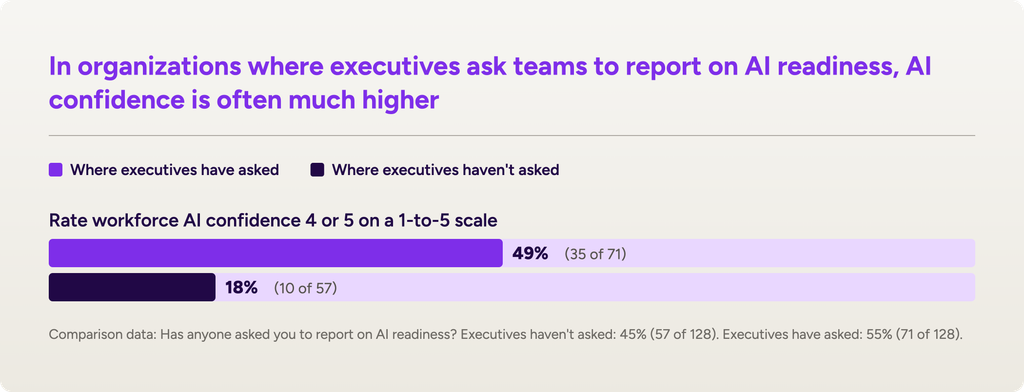
Meanwhile, the people responsible for readiness (HR, L&D, and enablement) are often working without a scoreboard. In our recent AI pulse survey of 128 business leaders, 45% of respondents say executives haven’t asked them to report on AI yet. Where someone is asking, 49% rate their workforce a 4 or 5 for AI confidence. Where no one has asked, it’s 18%.
The AI readiness gap
In March, we surveyed 1,000 learners and 1,000 learning leaders. 85% of learners said the AI training they get doesn’t help them fully understand or use AI in their role, and one in five had received none at all.
In November, we asked 128 leaders across L&D, HR, IT and more where employees get stuck most. Two of their answers line up with what learners told us in March:
Relevance to the role. In March, 57% of learners said their training wasn’t very relevant to their role. In November, 51% of business leaders said employees don’t know how to apply AI to their role.
Time. In March, 56% of learners said they don’t have enough time in the day to learn AI. In November, 30% of business leaders said employees have no time to experiment.
Three more gaps showed up in November: 32% say employees are unclear on what’s allowed when it comes to using AI, 22% say their AI tools don’t connect to company data, and another 22% say employees don’t trust the outputs.
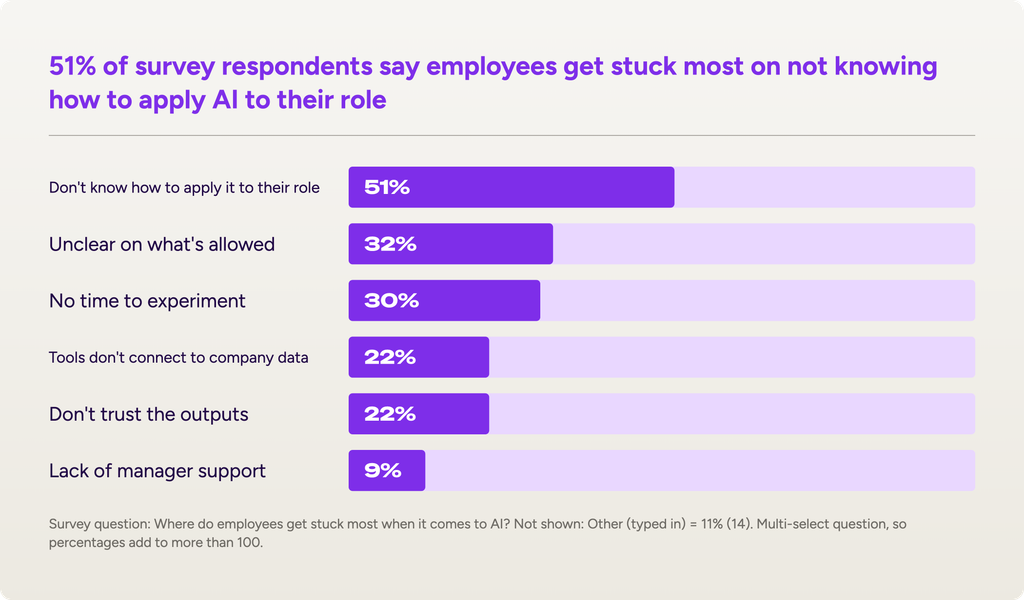
The pattern holds across both studies: people have the tools but lack the know-how, the time, or the clarity.
“We have a policy limiting use to ‘approved tech’ but no leadership vision for the future of what AI means for our company, and that vision is needed right now.”
HR/L&D Leader, Healthcare, 10,000+ employees
Follow the money
Part of the gap is a budget story. Our 2027 Skills Intelligence Report surveyed more than 1,000 HR and L&D leaders across Europe and North America:
53% named AI literacy their most critical skills gap, yet closing skill gaps for AI adoption ranked fifth of six on their list of learning investment priorities.
47% of those who asked for headcount to close the gaps said the money went to other priorities, AI tools among them.
Two-thirds said AI tooling investment grew as fast as, or faster than, their learning and enablement budget last year.
Egle Vinauskaite, Director and Strategic Advisor for AI in L&D at Nodes, puts it plainly:
“Investing in tooling but not in enablement is a category error.”
Egle Vinauskaite, Director and Strategic Advisor for AI in L&D, Nodes
Nothing forces anyone to weigh tool spend against training spend before the money is committed. A CIO in the room where AI budgets get set can ask that question first.
Signals that point to readiness
“The role of the CIO is also changing. You’re no longer just the steward of technology. You’re helping design the future of the enterprise because the nature of work is changing.”
Neeraj Mathur, CIO, SickKids Foundation
The strongest pattern in our recent survey of 128 business leaders is who’s in the room, and when.
Timing. Only 41% of business leaders are involved before tools are selected or while plans are being made. 43% hear about it after tools are in use, or not at all.
Shared goals. Only 14% have formal shared readiness goals between HR or L&D and IT, and 41% have none. In organizations where shared AI goals are formal, 83% are confident their workforce can use AI effectively. Where there are none, only 19% are.
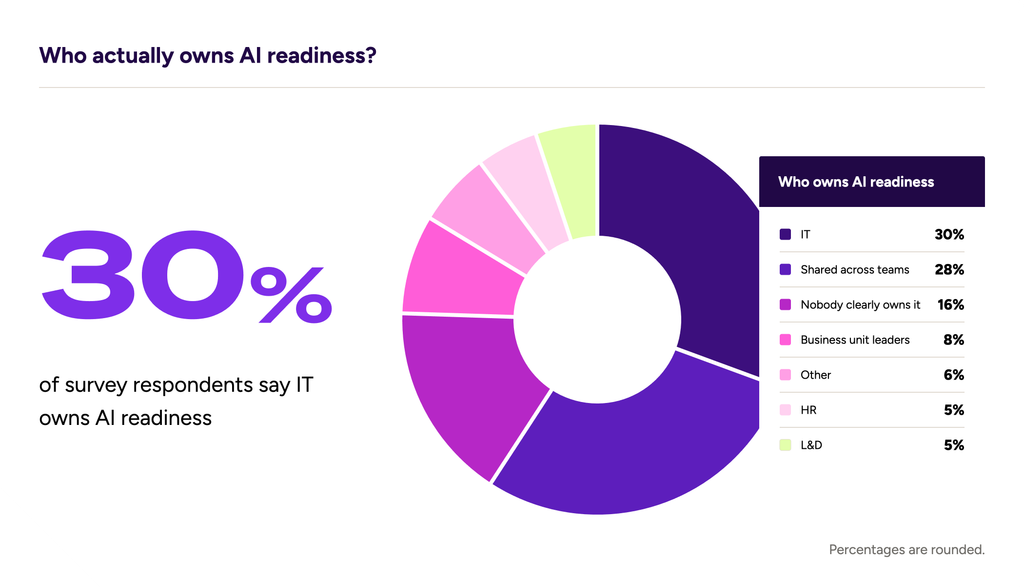
Ownership. IT owns AI readiness in 30% of companies, and 28% say it’s shared across teams. Where nobody owns it, only 14% are confident their workforce can use AI effectively.
“We need to be involved in the AI implementation from the beginning. We are the ones who need to champion it.”
Allana Bowman, Manager, Organizational Learning & Strategy, PDMI
Four IT playbooks for AI upskilling
None of the IT leaders we spoke to started with a master plan. There was no AI readiness playbook to copy paste. They started with a rollout, watched what stuck, and adjusted.
Below are snapshots of what’s worked thus far. Four different paths, one shared lesson: you can’t put tools in front of a workforce and expect people to figure it out. Our learning leaders know that one all too well.
Workato: from tools to company data to daily habits
Carter Busse, CIO
The big insight. Adoption didn’t come from better tools. It came from connecting AI to company data and changing IT’s role. In 2024, IT built agents it thought people would want. People called them neat, but ultimately broad adoption didn’t follow. Without company data, Carter says, AI is “just a glorified Google search.” Adoption took off in summer 2025, when MCP servers let AI search and act in HR and CRM systems. IT went from building to coaching.
What they did
- Ran enablement sessions twice a day for three weeks, at 8:00am and 5:00pm.
- Now hold a weekly Thursday session that reaches all 38 countries their employees reside in, alternating basic and advanced use cases. The business technology team provides a different topic for each session, and reserves half the meeting to answer questions.
- Celebrate “heroes” in company Slack channels, with lunch and learns and hackathons that include prizes.
- Show leaders’ own AI use and outcomes, because “it just can’t be an armchair CIO anymore.”
Also learned
- The blocker is time. People have ideas and can’t find hours to try them, so the goal is to give time back.
- Heavy token users are “a bit of a whack-a-mole.” Most are doing innovative work, and some are inefficient and get shut down.
SickKids Foundation: segment the workforce
Neeraj Mathur, CIO
The big insight. Neeraj thinks of AI enablement in maturity levels. Level 1 is “Everyday AI”, individual productivity tools for everyone, with Copilot on by default. Level 2 is “Workflow AI” with purpose built end-to-end AI solutions for cross-functional tasks. Level 3 is “Enterprise AI”, with orchestration across systems and workflows, which requires a trusted data platform, and a high level of data quality and mature data governance.
He also thinks about the workforce in a similar three-level approach.
What they did
- Sorted staff into AI early adopters, the AI curious, and the AI hesitant.
- Put staff through the AI Academy in cohorts, and finishing it unlocks access to Enterprise accounts of ChatGPT and Claude.
- Created an AI squad in the IT team that holds open hours where staff bring ideas and get help in developing them further.
- With everyday AI already in place, and over 80%+ staff using approved AI productivity tools, the current focus is on enabling more complex end-to-end workflow AI. The AI squad has a target to enable 4-5 use cases each year.
- The people, process, and platform foundation for future Enterprise AI is also being laid with Data Governance, Data Literacy, and Data Platform initiatives all in the works.
Example AI workflows:
- Built a thank-you letter workflow that drafts personalized CEO letters for gifts over $5,000, about 1,200 to 1,500 a year, a process that used to take 2 weeks to even 2 months, reducing the lead time to a target of 48hrs or less.
- Built a call-report agent that lets fundraisers talk through a donor call on-the-go and files the report in the CRM. Being actively used by staff with over 80 reports being logged each month.
Also learned
- AI Academy graduates join a group chat to share learnings, failures, tips, and tricks. The squad is “virtual,” a group of staff who support peers with AI while doing their day jobs. There is no dedicated AI support team yet, due to resource constraints.
- People & Culture helped set up the AI Academy, and L&D helps place it in learning plans. Next up is embedding it in performance priorities.
- Neeraj advises the strategic planning committee, the CEO, and the executive leadership team on the talent the organization will need, since working with AI is becoming a baseline skill for everyone.
Docebo: a hub and spoke model
Nitin Chopra, CIO and CISO
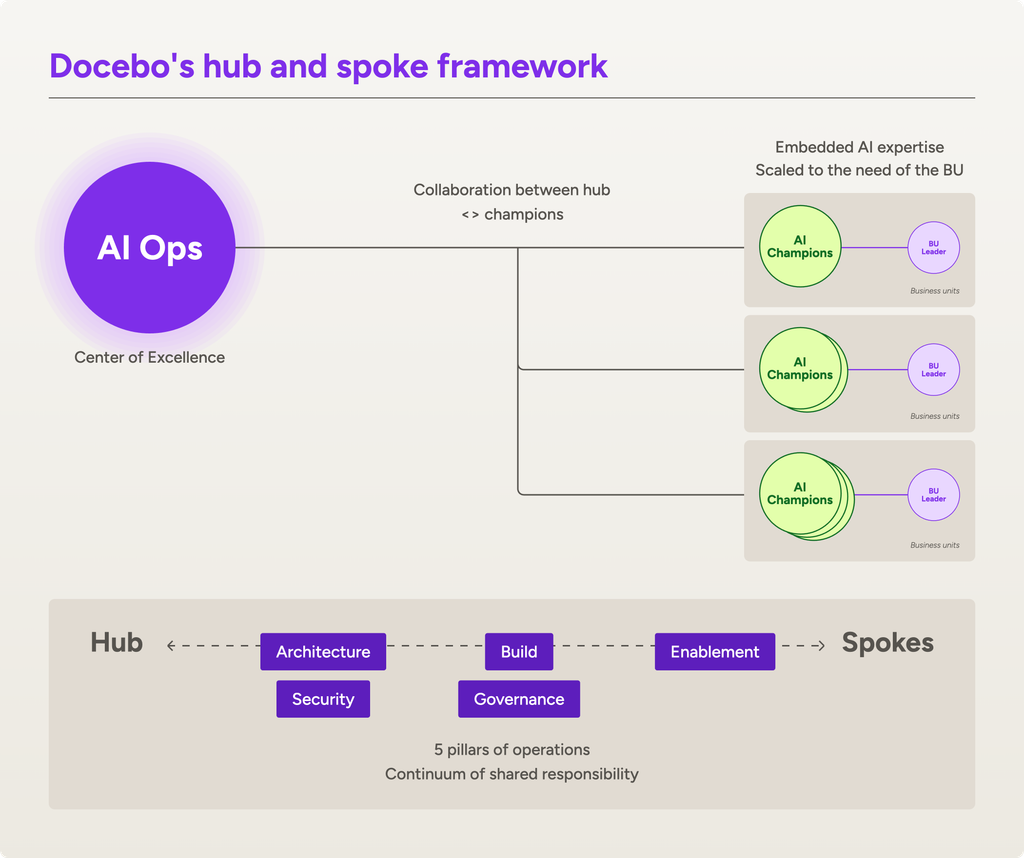
The big insight. Don’t let one AI team become the bottleneck. Nitin’s AI Ops team started as the group that did the work. A few quarters in, he saw it wouldn’t scale: the noisiest internal customers got most of the attention, and smaller teams got little. So Docebo moved to the hub and spoke. AI Ops is the hub, paving the way with model access, tooling, and a security and governance layer. Each department builds its own AI capability through a champion tied to the hub, because the hub could never match the depth of marketing, go-to-market, or legal. “You can’t just put tools out into the world and say that people are going to just figure it out.”
What they did
- Set up three distinct roles. AI Ops builds the ecosystem, the champion bridges hub and ground level, and the business leader owns the outcome.
- Named two kinds of champions, often promoted from within. Makers build and experiment. Catalysts translate the business and teach the mindset shift.
- Started a guild of AI-first individual contributors, with budget to travel and spend time together in 2027.
- Gave experiments a $5,000 proof-of-concept budget with few hoops. Nitin expects 70% to fail, and says that’s the point: spend $5,000 instead of $50,000, then pivot.
- Mixed formats: lunch and learns, build days, public Slack channels, and showcases at town halls.
- Watches Slack for people posting about AI, then reaches out to certain candidates who show potential becoming new AI champions.
Also learned
- Security that enables people. Nitin runs security, and every decision gets one test: does it make people feel enabled or blocked?
- HR is brought in from day one. Build days run alongside HR, who help measure results.
- Nitin sees value in more structured, role-based AI learning. Once that content is built out at Docebo, he wants to measure the impact.
Kinaxis: a safe place to experiment
Krista Swanson, SVP of Corporate IT
The big insight. Speed comes from guardrails, not gates. Krista’s team started with the standard IT playbook of stage gates and layers of sign-off, then reset. “IT’s job now is to provide the environment and the tools to experiment rather than give them the end solution.” Secure the platform and make the guardrails clear.
What they did
- Moved decisions down to smaller teams.
- Gave everyone a common toolset, because “the common language has to be the common toolset.”
- Stood up an AI governance council early last year, then split it into lanes with the business, with legal owning legal governance.
- Framed AI for the IT team as a career opportunity, not a threat.
Also learned
- Her test for any choice: is it a cement wall, a permanent fix for a permanent problem, or a sandbag, a temporary tool you can move as the business grows? “We’re in a sandbag time.”
- People who invest a little weekend time are outpacing their peers. “I can’t train you on everything because it’s going so fast.”
- In investment planning, she asks every leader which business processes AI can make better. The aim is AI-native processes, not AI sitting on top.
What the research says about what works
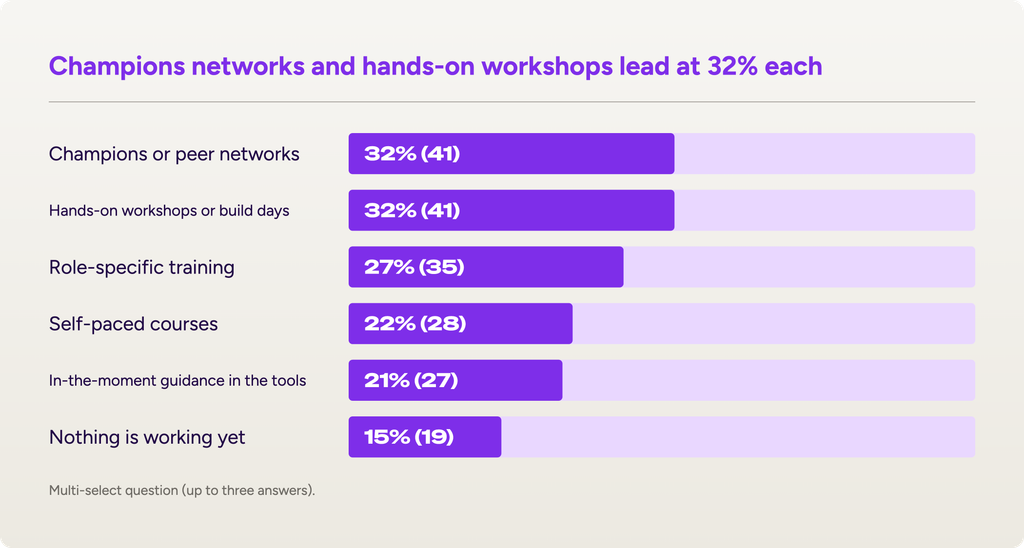
Of the 15% that say nothing is working yet, and only 1 of those 19 is confident their workforce can effectively use AI, against 35% overall.
“Tools are changing wickedly fast, meaning that no course is going to age well against the speed of AI tool development and deployment.”
L&D leader, healthcare, 1,001 to 5,000 employees
AI readiness has two halves
Your people need to learn how to work with AI. And your AI needs to learn how your company works. Our survey shows both halves: 51% say employees don’t know how to apply AI to their role, while 22% say the tools don’t connect to company data and 22% say employees don’t trust the outputs.
“Treat AI as an intern. Explain exactly what you need and want along with providing information on what you’re working on.”
Elena Saenz, Training Manager, Fred Loya Insurance
The metaphor runs in reverse, too. Docebo’s SVP of Product, Scott Peacock, describes most workplace AI as an unprepared intern: fluent, confident, and never onboarded to your content, policies, or procedures. “Mostly right” isn’t good enough where answers have to be accurate and auditable.
And as Nitin Chopra warns, if people get inaccurate or unhelpful answers, they stop coming back.
Learning and knowledge feed each other
Nitin draws the line: “learning and knowledge go hand in hand. They’re not two separate things.”
Months after a new microwave line launches, a salesperson on a call searches for the wattage. That’s knowledge, not learning. But when people across the organization keep searching for the same thing, (say, how to best pitch the new microwave), that’s a readiness signal that can lead to dedicated enablement on a topic.
Knowledge helps your workforce find information in the moment, learning helps build the skill and expand capability.
Readiness sticks when people can find the right answer and act on it. Docebo Knowledge delivers trusted, permission-aware answers from company content and learning. Docebo Agents turn that guidance into action, delivering the right next step at the right moment.
Pick tools that carry both halves
For any AI tool that sits between your people and your company’s knowledge, four questions are worth asking:
- Is it grounded in your own content, with each person’s permissions respected?
- Does it meet people in the assistants and tools they already use?
- Can you see, and approve, what it does?
- Can you see what it costs?
Governance is part of every choice. Carter Busse says what worries him most is “I don’t have visibility on a lot of the tools that run on laptops.” His comfort comes from governed tooling: “If they’re using our MCP servers powered by Workato, I’m not worried about it.”
Measure what moved, not what was clicked
The CIOs we spoke to have each hit the limits of the “easy” metrics.
Usage tells you the least. Neeraj Mathur: “It’s easy to measure, but it’s the least informative.” SickKids Foundation defines productivity outcomes more in terms of workflow lead time. For example, the call-report agent allows fundraisers to capture call notes immediately after a meeting using voice dictation, and this gets fresh data into the CRM faster, reducing the lead time from days to 1-2 hours.
Count outcomes, not tokens. When AI vendors moved to usage-based pricing, Carter Busse’s team went from report cards on who was using AI to celebrating token-efficient agents. Efficiency keeps costs in check, but he says what matters most now is business impact. His clearest win: AI helped give front-line sales and customer success teams at least 20% of their time back, which coincided with revenue growth of almost 4%.
Pick a number that moved. Nitin Chopra says CIOs hate the word ROI because it’s nearly impossible to measure. What lands is specificity: “Can I be very specific about something? Can I say, ‘I moved a number from X to Y, for a specific workflow in a business?’” For example, a quarterly business review that took three hours to prepare now takes five minutes.
Set the baseline before you build. For a lot of early Docebo AI workflows, the team had no record of how long the work took before, which makes before-and-after claims hard to defend. Now, where possible, they capture those before metrics to help set clear baselines for future reporting.
Ask if it adds value. For Krista Swanson, the filter is whether the work helps customers and adds value to the company shareholders. “AI native processes mean looking across the process itself, and reimagining it from beginning to end. What would you do if you had the luxury of extra hands at each stage, and how would you change what you’re doing as a result?”
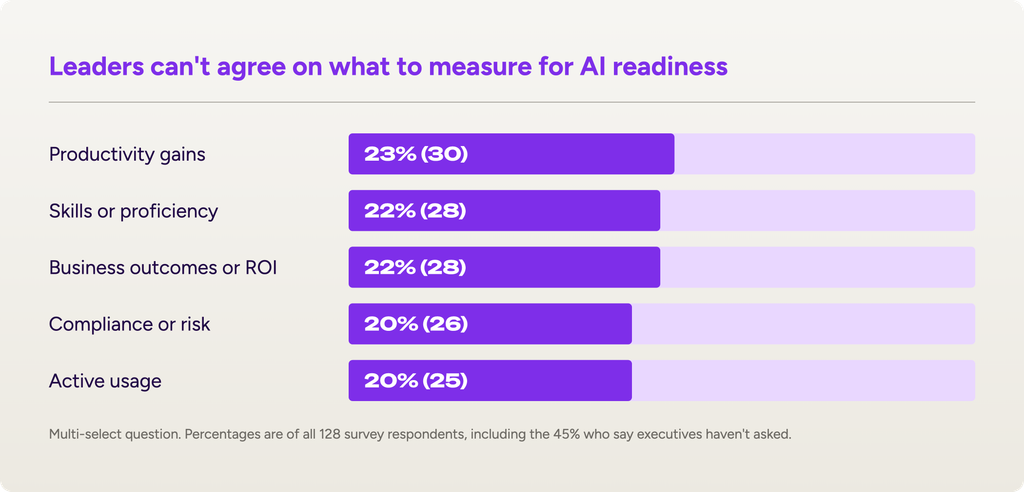
In organizations where executives do ask for AI readiness reporting, there’s no agreed answer on what success metrics matter most.
One more thing to measure. Asked what would tell them their workforce is AI-ready in 2027, one L&D leader at a tech services company said: “employees consistently applying human judgment to verify, shape, and take accountability for AI outputs rather than just passively using the tools or running basic prompts.”
Readiness needs to include human judgment, not just speed or output.
Fear, failure, and the mindset shift
When it comes to AI readiness, some of the hardest work isn’t technical.
Neeraj says some people still fear that adopting AI means “training their replacement,” and no amount of reassurance fully removes that. What helps, in his view, is “a culture of people openly and transparently sharing both their success stories and failures in using AI as a tool.” As that takes hold, he says, it helps the fear go away.
Nitin’s ask of every CIO and CEO is to “create room for failure,” because most posts on LinkedIn show the 1% that worked and hide the 99% that didn’t.
“You don’t get these moments all the time in your career.”
Krista Swanson, SVP of Corporate IT, Kinaxis
Krista also sees an unexpected upside. People are learning to direct agents, and to tell a story clearly enough that a machine does what they asked. Without anyone designing it, she says, “every individual contributor is now a manager. We will have stronger leaders 10, 15 years down the road just by default.”
Ideas on where to start
- Put AI tooling spend next to AI enablement spend and see if there are any clear gaps or opportunities.
- Give your workforce a safe place to experiment and share their AI wins.
- Pick one workflow, set a baseline, and move one number.
- Get IT, HR, and L&D into an AI planning session, focused on building readiness.
- Ask your workforce where they get stuck with AI, and fix the top blocker first.
- Name one clear owner for AI readiness, and build out shared goals across the organization.
- Publish a plain-language document on what’s allowed with AI, so your workforce has clear guardrails and guidelines.
- Name an AI champion in each function, and protect their time.
Meet your workforce where they are
AI readiness is a spectrum, and your workforce sits at every point on it at once. Docebo helps each of them take the next step.
Learning builds AI fundamentals and capabilities for people to expand their readiness. Knowledge helps people who are using AI to find trusted answers from curated content. Agents help people apply AI to take on specific tasks with specialized agents. MCP brings governed AI support into the flow of everyday work. And Skills Intelligence identifies emerging gaps and personalize learning, so people keep improving.
Whether your teams are just getting started or already rethinking how work gets done, see how Docebo helps your workforce take the next step.