


Docebo for CIOs
Make workforce readiness part of your enterprise infrastructure.
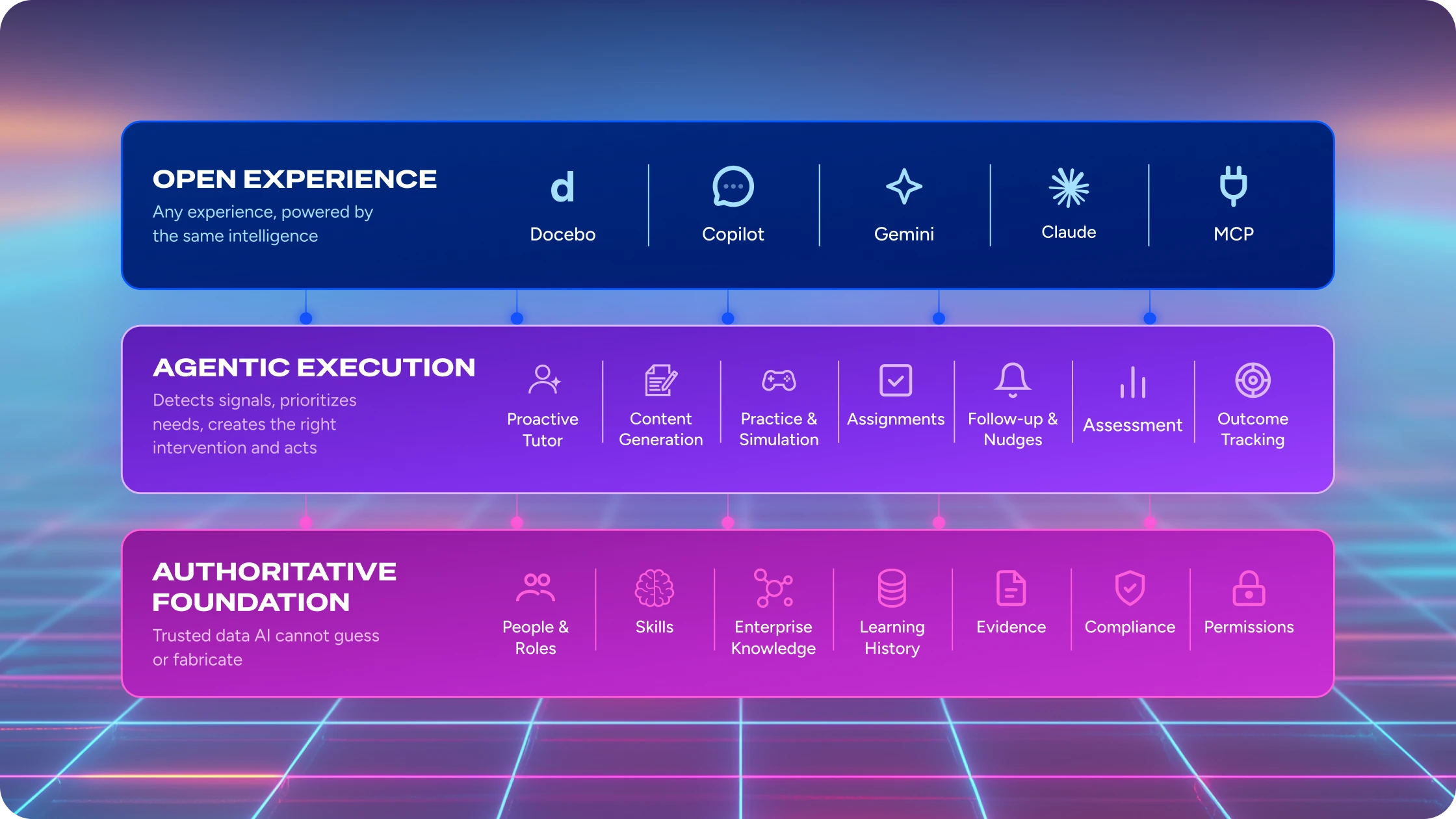
Connect every workforce capability workflow to your existing stack, with consistent permissions, data controls, and auditability built in.















Lower operating costs
Consolidate learning, skills, and AI capabilities in one platform to reduce tool sprawl, integration work, and administrative overhead.
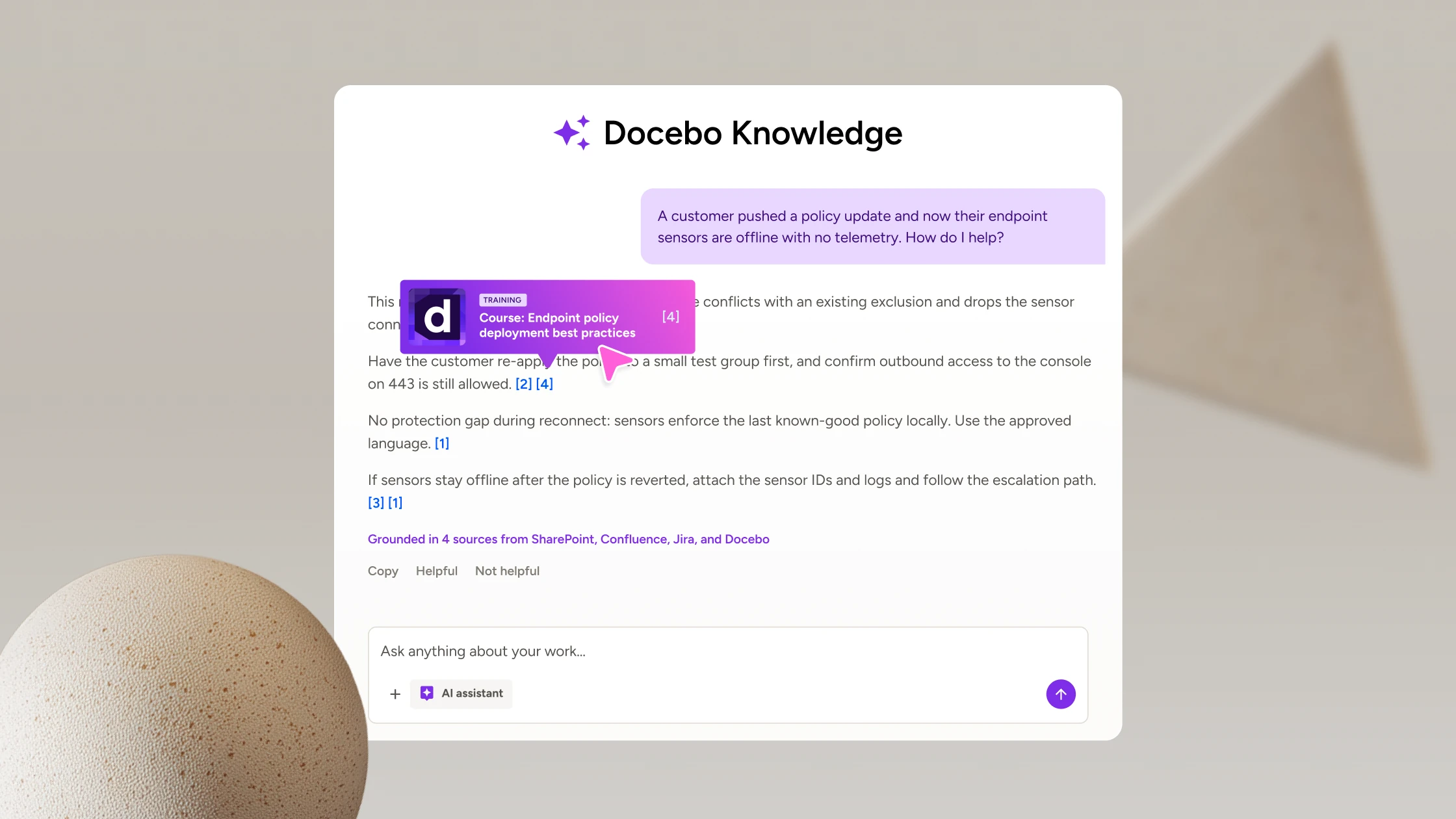
Put AI to work in context
Give people proactive, context-aware guidance based on their role, goals, and work, so AI helps teams act on what they need next.
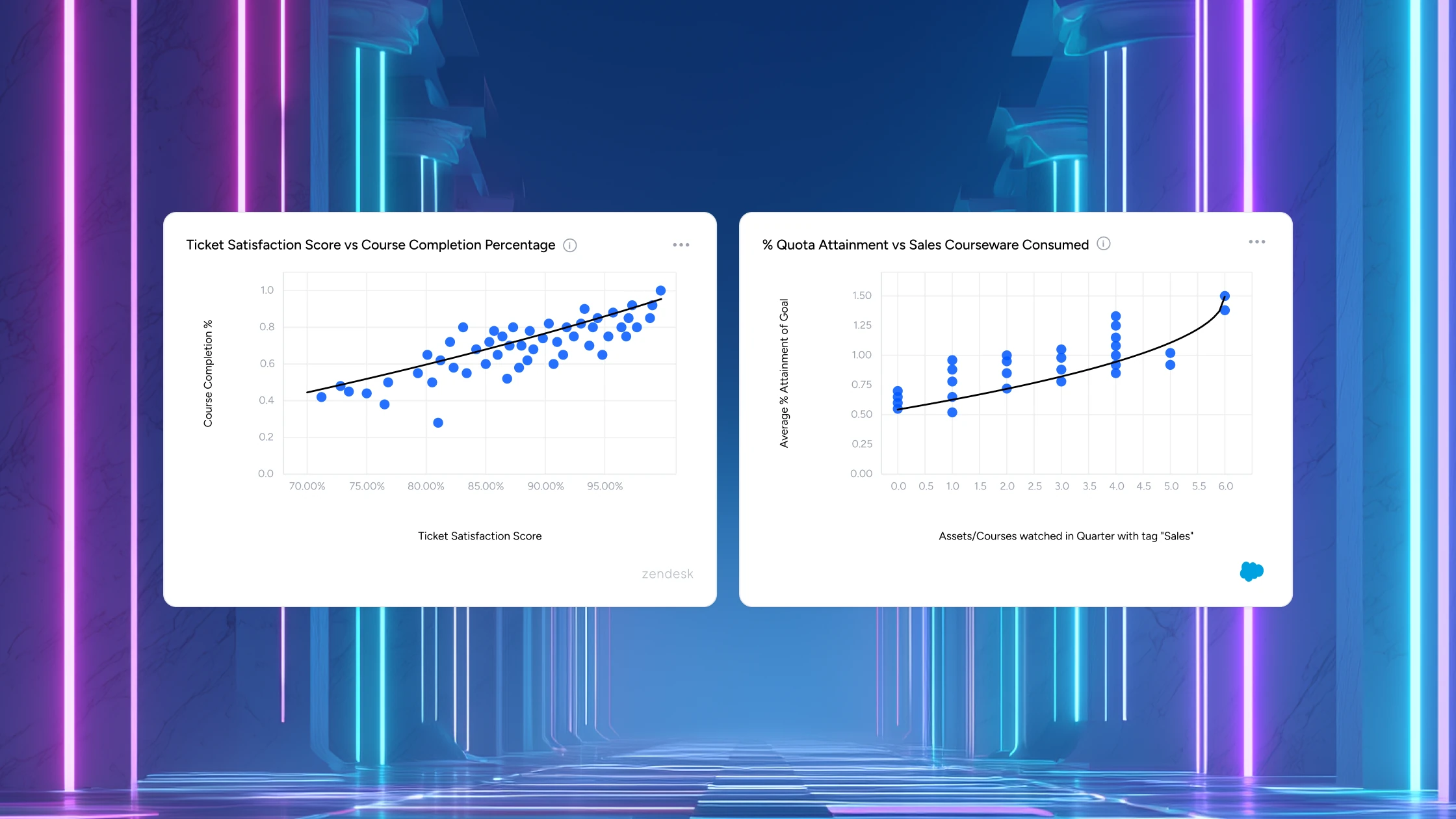
Measure readiness impact
Connect capability data to proficiency, compliance, and business outcomes so you can prioritize investment and focus resources.
We are at the forefront of business-to-business learning technology…Docebo empowers us to offer our clients not just today’s solutions but tomorrow’s innovations.
Max Moiseev
We chose Docebo not just for its scale, but for its openness… we could deeply integrate Docebo into our other core systems, making learning a seamless part of our digital ecosystem.
Vegard Øfstaas
For any company hesitating, if you take seriously the creation of a robust, scalable, and auditable learning environment, Docebo is an excellent choice.
Nataly Ozak
CAPABILITIES
Why IT leaders choose Docebo

Consolidate your stack
Scale learning and skills initiatives across regions and business units while keeping your technology footprint manageable.

Built for high standards
From Silicon Valley leaders to federal agencies, Docebo meets and exceeds rigorous security standards, including FedRAMP.

Keep data out of training
Your data never trains Docebo models or is shared with broader language models. It stays within your instance.

Sync your identity stack
Docebo works with your identity provider, including SAML, OpenID Connect, and just-in-time HRIS or directory provisioning.

Avoid custom build work
Docebo offers 400+ out-of-the-box integrations and workflow patterns, so you can connect enterprise data faster without custom development.

Assign roles with precision
Learner, power user, and super admin roles work with granular permissions, branches, and groups that reflect your org.

Roll out in phases
Discovery, configuration, migration, integration, enablement, and launch move at a pace that matches your team.

Run reliably at scale
Docebo runs on AWS with autoscaling, load balancing, and multiple availability zones, with regional hosting options available in your region or jurisdiction.

Use your data warehouse
Learning and skills data flows into the analytics stack your team already uses, not another vendor dashboard.
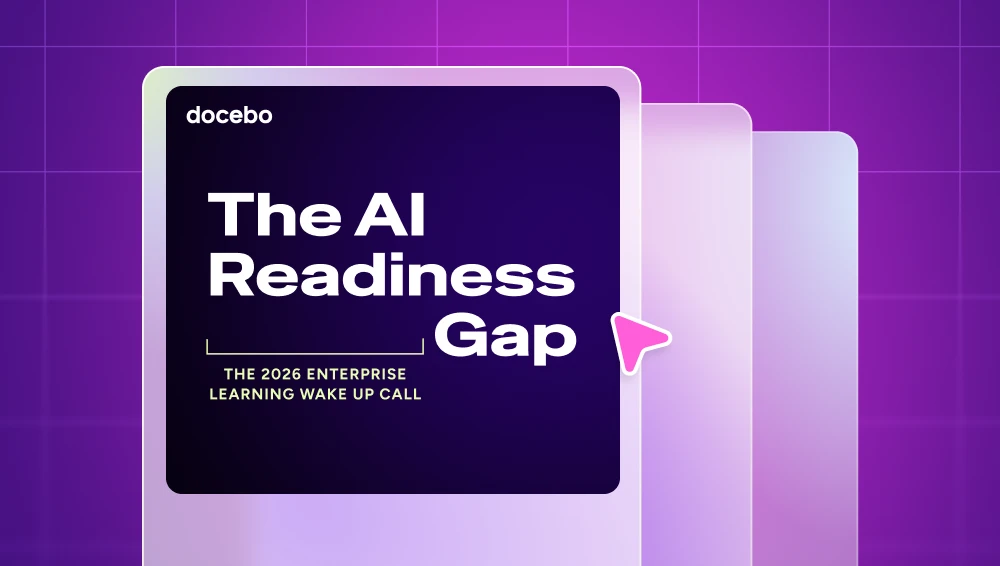
2026 Report
The AI Readiness Gap
Most organizations bought the AI tools, yet 91% say the work hasn’t fundamentally changed. See where readiness stalls, with data from 2,000+ learning leaders and employees.
Security & Integrations

Enterprise-grade security.
Permission-aware by design, so every person and agent sees only what they are allowed to see, every time.

End-to-end observability.
Track every query, answer, and agent action with complete logs, clear traceability, and audit-ready visibility.

Enterprise data governance.
Protect sensitive data with ISO 27001, SOC 2 Type II, and GDPR-aligned controls. Your data never trains models.
Built for the standards your business can’t compromise on.
Make your tech stack work harder for your people.







Relevant Resources
CUSTOMER STORY
How Trimble unified 15+ LMS platforms
See how Trimble consolidated its learning ecosystem on Docebo and improved completion rates.
CUSTOMER STORY
How CSI reduced learning administration
See how CSI unified training and reporting while cutting manual admin work by more than 50%.
GUIDE
AI Buyers Guide
Evaluate AI learning products, identify the right fit for your organization, and make more informed buying decisions.

More to explore
Platform
Connect Learning, Skills, Knowledge, and Agents in one AI-powered platform built to improve workforce readiness.
Agents
Build and deploy governed AI agents that execute learning and enablement workflows across your organization.
Knowledge
Surface trusted, personalized answers from the enterprise knowledge your people need to perform at their best.
Frequently asked questions
For your team, this is not four systems to secure and integrate separately—it is one. Docebo brings Learning, Skills Intelligence, Knowledge, and Agents together in a single Workforce Readiness Platform, so a readiness gap can move to recommended learning, relevant knowledge, and measurable progress without stitching together point solutions or managing four sets of permissions.
Docebo Knowledge does not require a new repository or a redesign of your access controls. It connects approved enterprise sources to permission-aware search and AI-powered answers, so people find trusted information while your team keeps source ownership and existing access controls in place. Knowledge also connects to Skills, Learning, and Agents, so an answer can lead to a course, certification, skills update, or escalation without a separate system in the loop.
Docebo runs as a SaaS platform on AWS, with API-driven services, load balancing, autoscaling, multiple availability zones, and regional hosting and disaster recovery options that support your resilience and data requirements. Your architecture team can review deployment patterns, data flows, and identity controls during evaluation, with Docebo specialists available for deeper technical review.
Every control is documented so your team can validate it, not take it on faith. The Trust Center, architecture documentation, and security questionnaires cover encryption in transit and at rest, annual SOC 2 Type II audits, ISO 27001 certification, third-party penetration testing, incident response, and disaster recovery—so your security team can assess what matters on its own timeline.
AI operates within the governance standards your team applies to enterprise technology: what data is accessed, who can access it, what AI can do, and how activity is monitored. Admins control which AI capabilities are enabled and what data they can reach. Every AI experience is limited to content a learner is authorized to view, and customer data never trains Docebo models or is shared with a broader language model.
You choose the integration pattern. Docebo connects through native integrations, REST APIs, webhooks, Docebo Connect, scheduled SFTP exports, and Learn Data pipelines into your data lake or warehouse. Use APIs and webhooks for real-time exchanges, scheduled pipelines for recurring transfers, and Docebo Connect where prebuilt connectors reduce integration effort.
Identity stays under your control. Docebo supports SAML and OpenID Connect, along with just-in-time provisioning and scheduled or API-based sync from your HRIS, directory, or CRM. It can support separate authentication experiences for employees, customers, partners, and members when your operating model requires it.
Yes. It is designed to standardize governance, not create another layer of exceptions. Learner, power user, and super administrator roles work with granular permissions for administrative tasks, while branches, groups, user fields, and automated rules assign the right experience and access to every audience across business units, regions, brands, and partner communities.
The goal is a platform your team can operate and extend after launch—not one that depends on Docebo indefinitely. Implementations move through discovery, configuration, data migration, integration, enablement, launch, and post-launch support in a phased rollout or broader launch based on your capacity. Your team can build with guidance, engage an implementation partner, or use a blended model.
One platform supports employees, customers, partners, members, and other extended-enterprise audiences, so scale does not require a new instance or vendor for every audience. Branches, groups, permissions, and catalogs manage complex organizations, while autoscaling, global content delivery, and regional hosting help map the design to user populations and rollout strategy.
Your reporting architecture—not a fixed one. Use in-platform reporting for operational insight, APIs and webhooks for event-based data, scheduled exports for recurring transfers, and Learn Data pipelines for broader analytics. Audit information tracks every change and shows exactly who updated a record and when.