


The L&D to-do list AI should already be handling
Something is shifting in L&D and HR right now, and it’s worth naming: the problems that have shaped this field for decades finally have a real answer.
Building a course from nothing. Keeping content current as fast as the business changes. Proving that any of it actually worked. These challenges aren’t new. What’s new is the energy in the room when people talk about solving them. Across every conversation we had at Inspire 2026, we heard the same thing in different words: people are done accepting these as permanent conditions of the job, and they’re already experimenting their way toward something better.
We asked 350 people where they’d point an agent first.
At Inspire 2026, we sat down with 350 L&D and HR professionals and asked a simple question: if AI could take something off your plate today, what would you hand over first?
The answers clustered fast, and they told us exactly where the appetite for change is strongest.
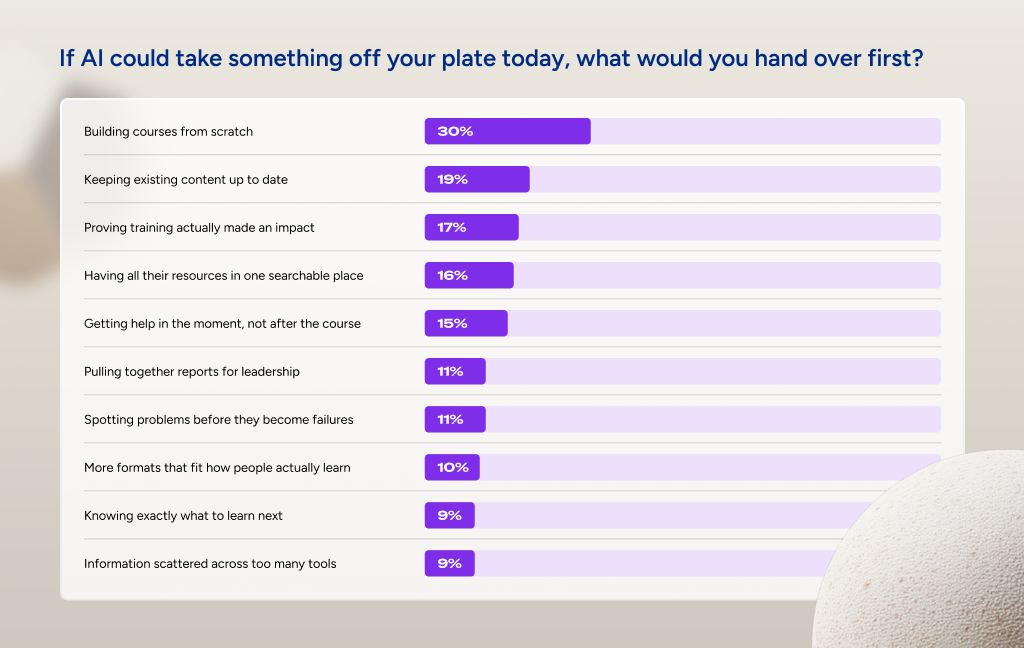
Course building topped the list by a wide margin, nearly a third of the room named it as their number one priority to hand off. That’s not a complaint. That’s a signal: This is where people see the clearest opportunity to reclaim their time for the work only a human can do.
People aren’t waiting. They’re already building the future themselves.
Talk to the practitioners closest to this work, and you don’t hear resignation. You hear people who’ve decided to get creative.
Take Micah Zirnhelt, Human Resources Systems Manager at Granite. His team wanted a way to catch external users sitting in pending approval before they became a backlog. So they built it: using Domo, their business intelligence tool, to query the Docebo API directly, surface those pending users automatically, and route alerts to the people who needed to act. It’s the kind of resourceful, build-it-yourself thinking that defines this moment in L&D. And Micah is already looking ahead to what comes next. As the Docebo MCP Server expands, he’s excited to bring that same workflow natively into the platform and simplify it even further. “We’ve played with the Docebo MCP a little bit and are excited for where it’s going,” he told us. “Once it grows a little more, we hope we can maybe make the agent just do it directly, which would be great.”
That same forward motion shows up in how his team approaches content. They’ve already built a Claude skill trained on their brand voice and imagery, producing on-brand documents and slides today. The next frontier they’re excited about: teaching that same skill to pull materials automatically from Box, Teams, and email, and turn them straight into finished course content. They’re not waiting for someone to hand them a solution. They’re building toward it, one skill at a time.
Jessica Alexander, Manager of People Technology at TEGNA, is standing at an even more exciting starting line. Her organization just migrated to Docebo from a patchwork of legacy systems, which means she gets to rebuild her course catalog with a clean slate and modern tools. “To have an AI agent that can help with that and make this really slick course,” she said, “is going to be extremely helpful.” She’s also picturing something that would have sounded like science fiction a few years ago: an in-course assistant that answers a learner’s question the instant it comes up, rather than leaving them stuck until the session ends. “It’s almost like sitting in a classroom where you watch a video with the teachers right there,” she said. “I think that is going to help provide a better learning experience and have the employee learn and retain more.”
The same optimism carries into reporting. Jessica pointed to how her organization already uses AI inside their ATS to skip straight past manual dashboard-building and get to the answer: what’s our time to fill, what does the data actually mean. She’s eager to bring that same shortcut to L&D analytics, especially in a fast-moving organization where the ask from leadership evolves constantly. “What the leadership wants today is not going to be what the leadership wants in three months,” she said. Rather than treating that as a source of dread, she sees it as exactly the kind of problem agentic AI is built to absorb; when the question changes, you just ask it differently, and the system keeps up. Her estimate of what that could save her: anywhere from eight to forty hours, depending on the ask.
Cory Davis-Gonzalez, Director of Global Learning, Policy & Development at Platform Science, points to a different corner of the same excitement: the volume of production work that eats up a day without ever asking anyone to think. “The repetitive production work is what I’d love to offload,” he told us, “like generating first-draft thumbnails and cover images for every new learning plan, translating course descriptions across five languages, or reformatting the same content into six different asset types.” His vision is a single source of truth, a Guru knowledge base article, say, that an agent could turn into a first-pass slide deck, a script, and a set of localized descriptions in one motion. “Some of this we are starting to do already,” he added, which is exactly the pattern showing up across every conversation in this series: people aren’t waiting for a finished product, they’re building toward it with what’s available right now.
So we asked each of them the flip side: is there anything they wouldn’t hand over to an agent? For Micah, the promise is wide open enough that the list of exceptions is short. “I don’t know that there’s anything that I wouldn’t let it do,” he said, pointing to enrollments, certifications, even branch management, as long as it comes “with appropriate testing and guard rails.” That caveat is where all three of them land in the same place — agents can run wide, but a human stays in the loop.
Cory draws that line with the most precision. “Anything that involves reading the room,” he said, stays firmly human, deciding how to frame a sensitive compliance topic for a specific region, or sensing what tone will actually land with a team that’s stretched thin. So does final sign-off on brand voice and accuracy in regulated content like ethics and compliance training. “AI can draft it,” he said, “but a human needs to be the one who signs off that it’s right, respectful, and actually going to resonate with the people receiving it.” Far from a limitation, that’s the shape of a healthy partnership: agents take on the assembly, people keep the judgment, and everyone gets more time for the part of the job that actually needs them.
These challenges are old. The momentum to solve them isn’t.
L&D and HR teams have carried real constraints for as long as the field has existed. Two people running learning for 8,000 employees, as we covered in the first post in this series, is a familiar reality for a lot of practitioners, and it’s exactly the kind of constraint that sparks resourcefulness rather than resignation.
What’s different now is the sense of possibility. The instincts Micah, Jessica, and Cory describe, building a clever workaround today while looking ahead to native tools tomorrow, using Claude to get a head start on brand-consistent content, are a glimpse of where the field is heading. Course creation, content upkeep, proving impact, surfacing the right resource at the right moment, every item on that top-ten list is a workflow an agent can be built to run, and the people closest to the work are already leaning in.
That’s the story this series is telling, a reimagining of L&D work, and what that opens up for the people doing it.
Up next
In the next post, we’ll dig into which agents the 350 practitioners we surveyed are most excited about, and how those preferences shift by role. (Spoiler: the person building courses and the person running reports for leadership aren’t dreaming about the same agent.) Then we’ll get into how Docebo’s AgentHub and MCP Server are built to meet that excitement head-on.
If you want to see where your own organization stands before we go further, the Workforce Readiness Index is a good place to start.