


Stop hoarding content: Why your learning strategy is failing and how to fix it
Access to learning content has never been easier. Whether it’s leadership development, compliance training, or niche technical certifications, there are hundreds of thousands of courses one click away. Your LMS content library keeps growing, but so does the sense of content overload.
But here’s the reality we hear from L&D teams every day: bigger libraries aren’t solving the real problems. Employees still can’t find what eLearning content they need, admins are drowning in vendor management, and leadership still can’t see the business impact of their investment.
In many organizations, learning strategies fail when teams can’t put the right content in the right place at the right moment in the workflow, and prove that it worked.
An LMS shouldn’t be “shelfware.” It shouldn’t be a confusing maze of links or a fragmented jumping-off point to a dozen different portals. If your system is difficult to manage and disconnected from results, it’s a liability.
The high price of fragmented learning
As your organization grows, so does the chaos of your learning ecosystem.
You might end up with one provider for compliance, another for soft skills, and a third for technical content. Managing them all at once can look like more choice, but it usually creates operational friction. Learners experience this as content overload inside an LMS content library that feels impossible to navigate.
L&D teams end up wasting hours on manual tasks: reviewing, importing, and tagging content across disconnected systems. Reporting becomes a nightmare, making it impossible to see which programs actually move the needle. The result? An administrative burden that grows with every new vendor you add.
This doesn’t just hurt admins; it confuses learners. When employees have to navigate a patchwork of interfaces to find a simple course, engagement drops before they even click “play.”
Friction kills momentum. If learning feels like extra work rather than a part of the workday, people simply won’t do it.
Quality over quantity: Why more isn’t better
For years, the industry was obsessed with library size. We assumed that more courses equaled more value. But we were wrong.
Massive catalogs overwhelm people. Generic content might check a box, but it rarely addresses the specific realities of your team’s roles or your business challenges. L&D teams then spend even more time tailoring or replacing that off-the-shelf content just to make it relevant.
The tide is shifting. Modern learning teams are shifting the question. It is no longer “How many courses do we have?” It is “How quickly can we put the right content in front of the right people and prove it worked?” Effective content curation, not catalog size, is what will drive impact.
Activating your content ecosystem
Forward-thinking organizations are moving beyond simple subscriptions. They are looking for ways to activate learning directly within their LMS. This means:
- Discovering and curating all content within a single LMS content library. .
- Delivering a consistent experience across all providers.
- Managing governance and content lifecycles at scale.
- Measuring real impact and performance across the company.
- Eliminating manual, repetitive administrative work.
This is where Docebo’s Content Marketplace comes in. It’s built on a simple goal: get the right content discovered, deployed, and measured in less time.
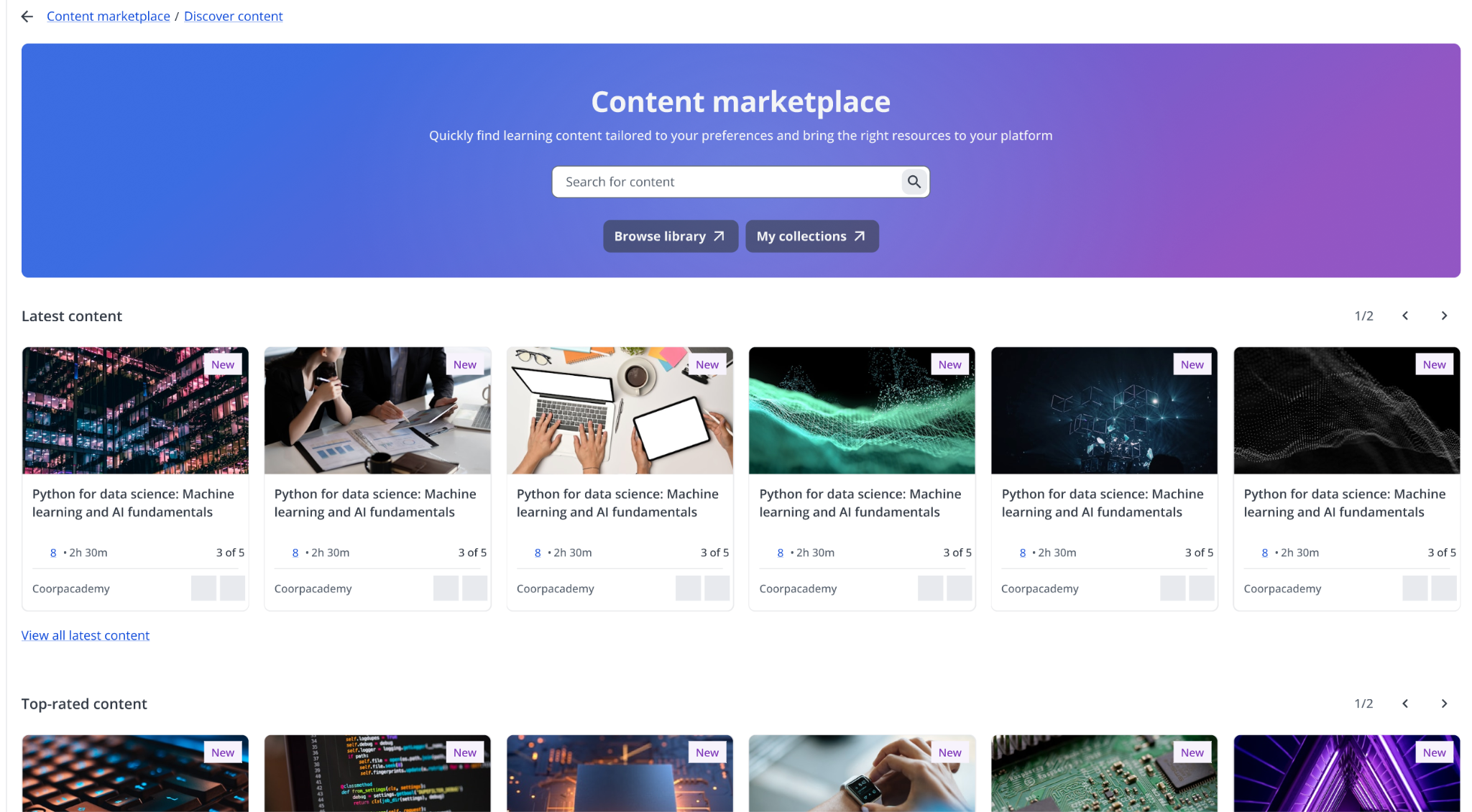
Instead of being another disconnected library, Docebo’s Content Marketplace centralizes third-party content directly inside Docebo’s workforce readiness platform. Content from partners like OpenSesame and Go1 lives in one workflow, so admins can discover, preview, import, and measure everything in a single, integrated experience.
And with our new curation agent launching this Fall, admins can offload the repetitive work of discovering, importing, and swapping third-party courses when content expires or needs a better fit. Instead of clicking through multiple provider portals, you get guided content curation inside Docebo.
When the manual lift goes away, learning teams can spend more time on strategy: designing programs around the skills that matter, tracking usage and completion, and using Docebo’s reporting to see what is working. This is what allows leaders to move from asking “How many courses do we have?” to “Which programs are worth doubling down on?”
By reducing friction, you improve adoption and make it easier for your content investment to support workforce readiness.
The future is results
Abundance creates a new challenge: noise. As AI makes it easier to create content, organizations need better ways to govern and curate the experiences that actually matter.
The future of enterprise learning won’t be defined by who has the biggest library. It will be defined by who helps organizations turn learning into measurable results.
Access is just the start and activation is the goal. Docebo’s Content Marketplace is built for this shift, helping you cut through complexity like manual content curation to make learning your most strategic asset. Learning content should do more than fill a catalog. Explore how it can drive your business forward.