


What skills intelligence actually looks like in practice
In our last blog, we made the case for skills intelligence as the connective tissue between what your people can do and what the business needs done. Then, we promised you we’d get specific. So here we are.
A quick note on where we are in this series: we’ve recently gone over why L&D gets misaligned with business strategy, moved through the cost of measuring the wrong things, talked about what “learning you can measure” means in practice, and then landed on skills intelligence as the mechanism that makes all of it sustainable. If you’re joining mid-series, that’s the gist. Now let’s dive into the details.
Why is this important, you ask? Because companies using skills intelligence platforms report a 30% increase in internal mobility.
Do a quick mental calculation of what your organization spent on external hiring in the last 12 months. Now consider that a significant portion of those roles could have been filled internally if you’d had a clearer picture of who had the adjacent skills to step into them. That’s a lot of savings.
But how does one get there?
What a working skills intelligence system actually does
While a skills framework is a list, skills intelligence is a system. The difference is that a list sits still while your workforce changes around it.
We talked a bit about this last time, but let’s revisit it. A working skills intelligence system does four things continuously: it detects, identifying gaps in the process, then it delivers and lastly, it validates.
The role of AI and skills intelligence
The detect-deliver-validate loop only works at scale because of AI. Without it, you’re back to a list someone updates twice a year. AI is what turns skills and learning into something closer to workforce readiness: a live read on what people can actually do, updated as they do it, rather than a static inventory pulled out for an annual review.
The mechanism that makes this work is hyperpersonalization. Instead of training tied to a job title, the system tailors development to the unique skills, context, and shifting priorities of the individual learner. Two people with the same title can have genuinely different gaps, different adjacent capabilities, and different next moves available to them, and the system is built to treat that as the norm rather than an edge case.
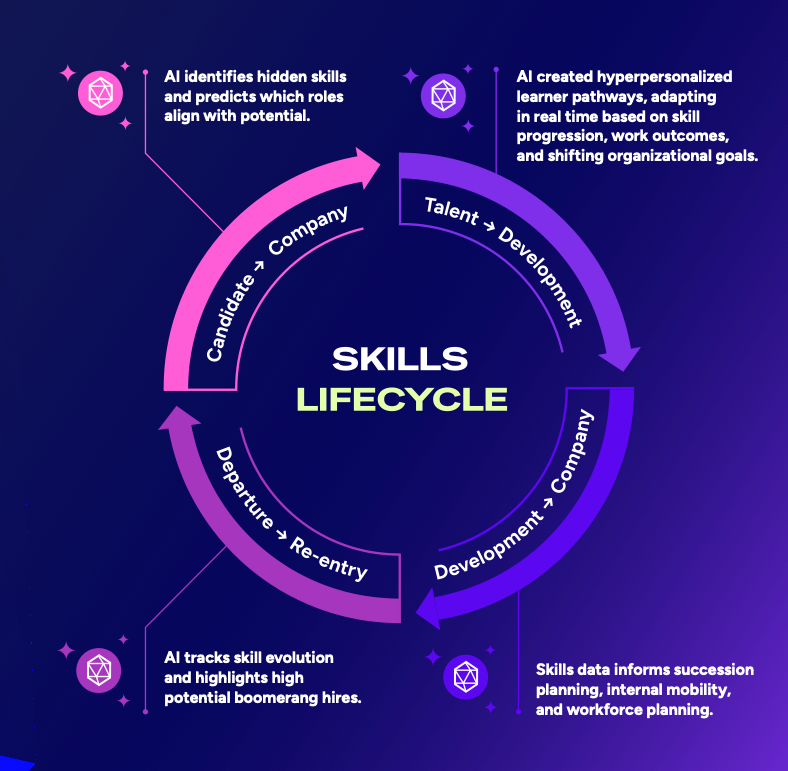
The payoff is what happens once skills become visible and actionable: learner growth and organizational agility start reinforcing each other rather than running on separate tracks. A person closing a real gap makes the org more flexible; an org with clearer visibility into its skills can route people into the right development faster. It’s a virtuous cycle, and it only spins up once you have a system instead of a list. So, how do you actually make that happen?
From skills insight to workforce execution: Docebo + 365Talents
This is where Docebo + 365Talents, an AI-first system built to operationalize skills across learning, work, and performance, comes in. The basic mechanics follow the loop already described. Skill gaps trigger learning, AI builds the content and personalizes the development path, and the system tracks all of it. Performance outcomes then inform what comes next, which means workforce decisions get smarter over time instead of resetting to zero with each planning cycle.
The best part is that a lot of the administrative weight that normally sits with managers and HR gets automated through agentic AI, identifying hidden and adjacent skills, routing validation to managers at the right moment rather than on a fixed schedule, supporting internal mobility decisions, and tracking skill progression as it happens.
And all of this is built for scale. Think global, complex enterprises, where data is fragmented and decisions span HR, L&D, operations, and the business. Docebo’s skills intelligence becomes a shared operating layer rather than a reporting tool, with support for external users and integration into the rest of the enterprise stack. You can read more about how it all works in our report “Skills + Learning: The playbook to workforce readiness.“
Great, how does this work in real life?
What this looks like with 155,000 employees
SNCF, the French national railway company, is about as complex an organization as you can find: 155,000 employees, enormous operational diversity, serious stakes around safety and compliance, and all the structural complexity of a national public institution.
And yet when they adopted skills intelligence through Docebo’s 365Talents, they achieved 83% platform adoption, and ended up with €100 million in savings.
Getting 83% of a 155,000-person workforce onto a learning platform and actively using it is a massive product win. People found that the system surfaced things they actually found relevant to their work and their careers, which in the end led to €100 million in savings.
How? The adoption led to better internal mobility, reduced external recruitment costs, and a more efficient approach to compliance training that wasn’t redundantly covering things people already knew. When you can see skills at the individual level, you stop spending money training people on capabilities they already have.
But it’s important to note that this was achieved because the company synchronized how talent and learning cooperated internally.
Talent teams and learning teams still mostly operate from different data sets, different meeting rhythms, and different success metrics. Talent looks at headcount, attrition, and succession while learning looks at completions, time-in-training, and satisfaction scores.
Here’s the issue though: skills intelligence only works if both teams are looking at the same data. That happens to be genuinely hard to execute because it requires someone to own the shared data model, and that person doesn’t always have a clear home on the org chart.
The organizations that make this work tend to have either a Chief People Officer who’s actively pushing integration between the two functions, or an L&D leader who’s made the business case for a seat at the workforce planning table and has the outcome data to back it up.
Where this leaves you
If you’re evaluating skills technology, the questions worth asking are whether the system updates in real time or only on a schedule, whether validation is built into the loop or bolted on as an afterthought, whether the skills data is actually shared with talent and workforce planning teams, and whether the learner experience is designed around the learner’s career goals or around the administrator’s reporting needs.
The SNCF numbers aren’t magic. They’re the result of a system that answered those questions well enough that 83% of employees found it worth their time to use.
Ready to see where your organization stands on skills? The AI Readiness Gap: The 2026 Enterprise Learning Wake up Call report has the full data on where companies are getting this right and where they’re leaving the most ground uncovered. [Download it here.]
Want to go deeper on the skills side specifically? Learn more about skills intelligence and what a mature capability looks like in practice.
Up next: We’re moving from infrastructure to impact. In blog 7, we’ll look at Insurity, which took a fragmented, expensive, in-person training model and rebuilt it into a unified digital learning ecosystem covering employees, customers, and partners on a single platform. We’ll discuss how personalized learning is key to ensuring growth.