


What is agentic learning? And why does it matter right now?
Recently (at Inspire 2026), we asked 350 L&D leaders one question: If AI could do the work for you, what would you actually hand off?
Not surprising for anyone, the number one answer was building courses from scratch (we’ll dig into the data in more detail in upcoming blogs so stay tuned).
They wanted relief from work that’s repetitive and time-consuming. And that’s precisely what we’ll talk about in this Agentic Learning series. Grab your coffee, and let’s read on.
Where most of us actually are (when it comes to AI)
We asked over 2,000 L&D leaders, and so far, only 9% of organizations have used AI to genuinely change how work gets done, with 35% stuck in experimentation mode.
Pilots get launched. Tools get procured. Course completion rates climb. And then… not much changes.
If that sounds familiar, it’s because the gap between “we use AI” and “AI changed how we operate” isn’t a technology problem. It’s a maturity problem.
In our recent DU Live webinar with Avery Grammel of Datadog, where she walked us through how she leverages Claude to enhance her use of Docebo, Avery beautifully framed this maturity problem through the lens of the change curve, the psychological framework Kübler-Ross originally developed to map the stages of grief (which, relatably, is also how a lot of people feel about AI today).
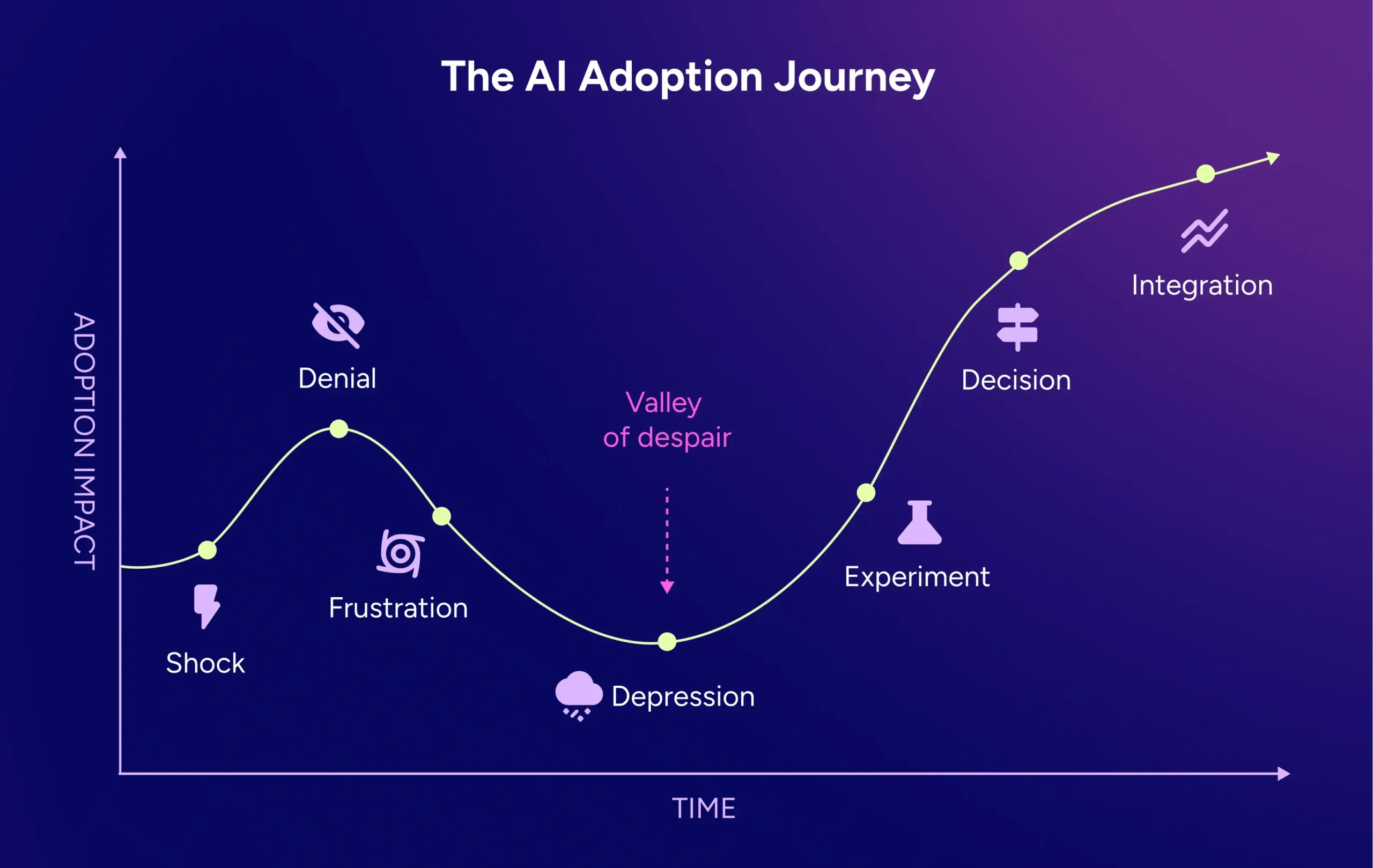
You move through shock, resistance, and frustration before you get to experimentation. Then a decision point. Then, eventually, integration. AI adoption is following the same arc for most organizations.
The good news: a growing number of L&D practitioners are asking the right next question. Not “should I use AI?” but “what does it actually look like to build AI into how I work?” That’s where agentic learning begins.
So let’s go back to Avery. Avery is a Learning and Technology Specialist at Datadog, a global monitoring and analytics company with more than 8,000 employees. She runs their learning academy, called Bits of Learning, with her manager Victor Serna.
Two people. 8,000 employees. Hundreds of external partners also in the platform. You do the math.
Avery’s team had 3,000 courses and enablement documentation scattered across Google Docs, Confluence, and spreadsheets. No consistent format. New team members couldn’t self-onboard. Enablement teams kept asking the same questions. So she used Claude to build an SOP template in Confluence, then trained every enablement team on one prompt. Paste the template link, drop in your program notes, and Claude generates a complete SOP in the same format. Hours became minutes.
Here are other ways that Avery streamlined her L&D workflows:
- Datadog syncs Workday data to Docebo every night, which means groups across dozens of cost centers, constantly changing. The spreadsheet tracking it all had become a multi-tab monster. Avery asked Claude to help her write a Google Apps Script that turned it into a filterable search interface. Admins now find what they need in seconds.
- With naming conventions that had evolved over years, Avery built an intake process: Admins submit a ticket with their changes, she reviews it, hits run, and a script pushes everything to the Docebo API. What used to be days of manual clicking takes minutes.
- Using Workato, she built an automation that checks every morning whether new courses have landed in the right folder. It reads the course code prefix, matches it to a folder, and categorizes it automatically. Nobody has to remember to do it, because the agent just does it.
- Avery used Claude to prototype multiple homepage variations and preview them before touching the live platform. She picked the direction she wanted, iterated on the CSS, and shipped faster than anything she’d done before.
The best part is that Avery is not an engineer. She learned to use Google Apps Scripts and API calls with Claude’s help, iterating her way to working solutions. And with agentic learning, Avery’s workflows could get further streamlined.
What agentic learning offers to L&D professionals
Most AI that people use at work is reactive. You write a prompt, you get output, you decide what to do with it. It’s a very fast, very capable assistant that does nothing unless you ask.
Agentic AI is different in one key way: it can be given a goal and a set of tools, and it’ll figure out the steps to get there. It initiates actions. It runs on a schedule. It responds to triggers. It doesn’t wait to be asked.
For L&D, that distinction is significant. A reactive AI helps you write a compliance reminder. An agentic system monitors completion data, identifies who’s at risk, drafts a personalized nudge, and sends it, without you opening the platform.
When we say “agentic learning,” we mean something specific: a learning ecosystem that doesn’t just support the work of L&D, but executes on it. One that closes the loop between skills data, content, and action without a human shepherding every step.
Let’s go back to Avery. Her setup is genuinely impressive. It’s also a preview of what becomes possible when the plumbing is already built for you.
Her workflows rely on her knowing how to prompt Claude for Google Apps Scripts, navigate Docebo’s API documentation, configure Workato recipes, and debug things when they break.
So what could make her process even smoother?
The next step is native agents: AI that already lives inside your learning platform, already connected to your courses, your skills data, and your learner history, and built to take action on L&D tasks specifically.
That’s what Docebo’s AgentHub is. Announced at Inspire 2026, it’s a no-code agent builder that lets L&D teams deploy pre-built agents or create custom agents without writing a line of code. An agent can scan compliance status and automatically trigger learning paths. Another can spot at-risk learners and send nudges. Another can build a draft course from your existing Confluence docs, SharePoint files, and Docebo catalog in minutes.
The agents that resonated most with those 350 L&D leaders at Inspire? Course builder agents, conversational analytics agents, learner nudge agents. We’ve got good news: they’re the exact use cases AgentHub is built for.
Docebo MCP Server is the other piece. MCP (Model Context Protocol) is a standard that connects your LMS directly to AI assistants like Claude, ChatGPT, and Microsoft Copilot. Your learners can check course progress and search training content without leaving the tools they’re already in. More importantly: the skills and learning data you’ve built in Docebo stops being locked inside the platform and becomes available to any AI agent, anywhere.
The difference between Avery’s approach and what AgentHub makes possible is the difference between building your own plumbing and having it already installed.
What’s next
This is the first post in a four-part series. Next up, we’re going deeper into how L&D and HR professionals are actually using AI today, the day-to-day tasks, the repetitive work, the places where AI is already making a real dent, and where the biggest unmet opportunity still sits.
If you want to benchmark where your organization stands before reading further, the Workforce Readiness Index is the place to start.
Stay tuned for our next blog in the series: “The L&D to-do list AI should already be handling.”
Want to see AgentHub or MCP in action? Request a demo today.