


8 Best internal mobility platforms for enterprises (2026 vendor shortlist)
Your skills data sits in a spreadsheet nobody opens. Open roles stay unfilled for months. And good people leave because they can’t see a path forward, so recruiting spend keeps climbing.
An internal mobility platform is supposed to fix this. But the term covers very different tools: an internal talent marketplace, a skills intelligence platform, or a job board bolted onto your human capital management (HCM) suite. Each one solves a different problem.
This guide compares the leading internal mobility platforms for enterprise organizations and shows which fits your stack and your primary problem. You’ll leave with a shortlist matched to what you actually need to solve.
How we chose these platforms
We evaluated each platform on six criteria: skills-data quality, opportunity matching, the learning connection, analytics and measurement, integration effort, and enterprise governance. Our research drew on vendor documentation, customer case studies, public product demonstrations, and G2 reviews accessed in July 2026. Full disclosure: Docebo publishes this guide, and Docebo Skills Intelligence is one of the platforms compared below.
What a modern internal mobility platform must be able to do
Start with the baseline. A modern internal mobility platform should surface internal roles, gigs, and projects. It should match people by verified skills rather than job titles, and give employees visible career paths.
Docebo’s product philosophy adds one more requirement. Skills have to stay current and connect to learning, or the marketplace decays. A match built on skills declared 2 years ago is a bad match today.
That distinction is why buyers confuse three categories that behave very differently: a talent marketplace platform, a skills intelligence platform, and an HCM job board. The next section separates them.
How the internal mobility platform category breaks down
No single platform wins for everyone. The right fit depends on your existing stack and your primary problem. Here’s where each vendor sits.
- Talent marketplaces (Gloat, Fuel50): Strong opportunity matching for gigs and roles, but no native learning loop
- Skills data layers (TechWolf): The intelligence layer only, with no employee-facing mobility or learning
- Talent acquisition and sourcing (Eightfold, Phenom, SeekOut): Built for hiring and matching, not reskilling execution
- Verified skills assessment (Workera, iMocha): Assessment-first, covering only employees who finish evaluations
- HCM suites (Workday, SAP SuccessFactors, Oracle HCM): Capture skills data, but update it manually rather than continuously
- LMS and learning experience platform (LXP) tools (Degreed, LinkedIn Learning): Treat skills as content tags, weakly linked to workforce decisions
- Talent and learning suites (Cornerstone): Broader suite with a stronger skills story, but less proven on closed-loop mobility and workforce outcomes
The real differentiator isn’t a feature checklist. It’s skills-data quality, and whether skills connect to learning and action.
Docebo is the only comprehensive data-driven learning platform that powers internal mobility with skills intelligence while also supporting external learning. Here’s how it successfully tackles the issues mentioned above: Docebo Skills Intelligence infers skills from real work and learning signals and keeps them current, rather than declaring them once or assessing them once.
How to evaluate an internal mobility platform
Run each platform through these six tests. Write them into your demo script so vendors answer the hard questions, not the easy ones.
Skills-data quality
Does it infer skills from real work, projects, and learning activity and refresh them automatically? Or does it rely on employees self-declaring their skills once and leaving them to go stale?
Opportunity matching
Does it match people to roles, gigs, and projects by verified skills? And can employees and managers actually see the matches and act on them?
Learning connection
When it finds a skill gap, does it trigger targeted learning and help you track whether readiness and development progress improved? Or does it stop at the recommendation? This is where most tools fall short.
Analytics and measurement
Can you report internal fill rate, adoption, readiness, and development signals by business unit, and connect those metrics to BI tools for deeper outcome analysis? Login counts don’t prove mobility is working.
Implementation time and ease of deployment
How long will it take to map the platform to your human resources information system (HRIS), your LMS, and your job architecture and get it live? G2 self-reported time-to-implement runs from about 4 months (Docebo) to 7 months (Gloat, Cornerstone, and Phenom; see each vendor’s G2 page linked in its entry below). Confirm what mapping your skills taxonomy and integrations will really take.
Enterprise scale
Check for role-based visibility, controlled eligibility, and multi-region, multi-language support.
At-a-glance comparison of internal mobility platforms
| Platform | Category | Best for | G2 rating |
| Docebo | Skills intelligence + learning | Learning-led enterprises connecting skills to development | 4.6* |
| Gloat | Talent marketplace | A mature, employee-facing gig and project marketplace | 4.4 |
| Fuel50 | Talent marketplace | Personalized career pathing and a common skills language | 4.4 |
| Eightfold | Talent acquisition | Recruiting-first teams with mobility as a secondary use | 4.2 |
| Workday | HCM suite | Mobility inside your system of record | 4.0 |
| Cornerstone | LMS/LXP | Compliance-grade learning with skills visibility | 4.1 |
| Phenom | Talent acquisition | TA-led teams extending into career management | 4.3 |
| Degreed | LXP | A skills-forward learning culture across many sources | 4.3 |
*4.8 (365Talents); 4.3 (Docebo LMS)
The 8 best internal mobility platforms
1. Docebo
Best for: Organizations that want to make internal talent more visible, match employees to roles and projects based on skills, and connect internal mobility to targeted development.
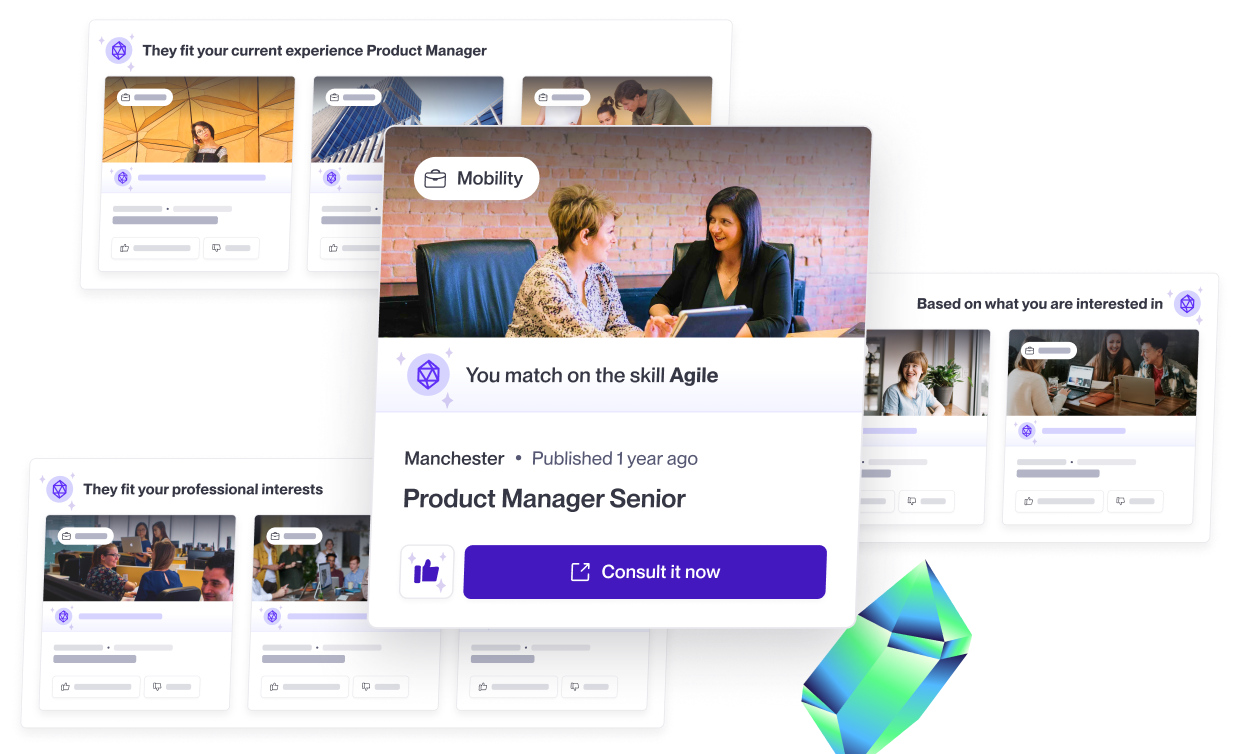
What it does: Docebo Skills Intelligence, powered by 365Talents, continuously identifies skills across the workforce and uses them to match employees to internal roles, gigs, and projects. It also connects mobility-driven skill gaps to targeted learning in Docebo, so organizations can fill work faster and make internal growth more transparent and scalable. This is the detect, grow, and validate loop, running end to end.
Key strengths:
- Continuously updated skills employees can validate and trust
- A native skills-to-learning loop no standalone marketplace matches
- Governed skills and job architecture, plus workforce planning analytics
Limitations: Docebo implementation can feel heavy for small teams.
Implementation and integration: 365Talents takes about 3 months and the Docebo LMS about 4 months to implement (G2 self-reported), with an open API to fit your existing HRIS ecosystem.
Customer evidence: “365Talents helps operationalize our skills strategy at scale – mobility, learning, workforce planning, everything connects and we never had this before.” (Verified User in Telecommunications, Enterprise, June 19, 2026, G2). According to Docebo’s customer data, SNCF reached 83% adoption within 6 months, increasing internal mobility and leading to €100 million in savings as a result.
2. Gloat
Best for: Large enterprises that want a mature, employee-facing talent marketplace for gigs, projects, and roles.
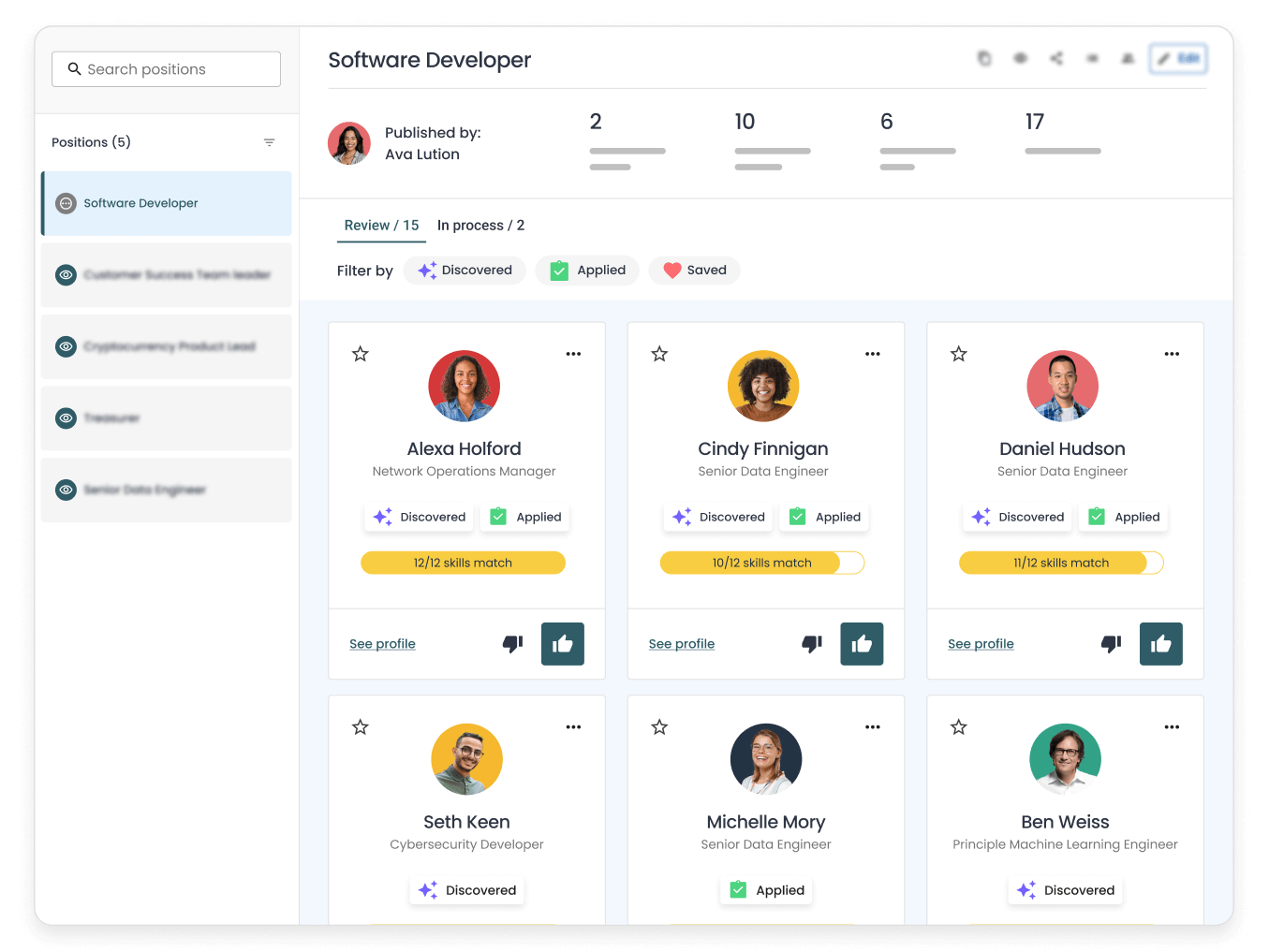
What it does: Gloat is an AI talent marketplace that matches employees to opportunities by skills and aspirations.
Key strengths:
- One of the first talent marketplaces, with fast AI matching
- A single place for positions, projects, and mentors
- A responsive team that ships updates monthly
Limitations: Adoption and usage data can be hard to extract, and unannounced UX changes disrupt admin teams (Elaine A., Enterprise, September 2, 2024). There’s no native learning loop.
Implementation and integration: About 7 months to implement (G2), and it requires out-of-platform change management to sustain usage.
Customer evidence: “Gloat’s talent marketplace tool was one of the first on the market. It was designed with the employee in mind.” (Michele E., Global Digital Transformation Lead, Enterprise, August 11, 2024, G2).
3. Fuel50
Best for: Organizations prioritizing personalized career pathing and a common skills language.
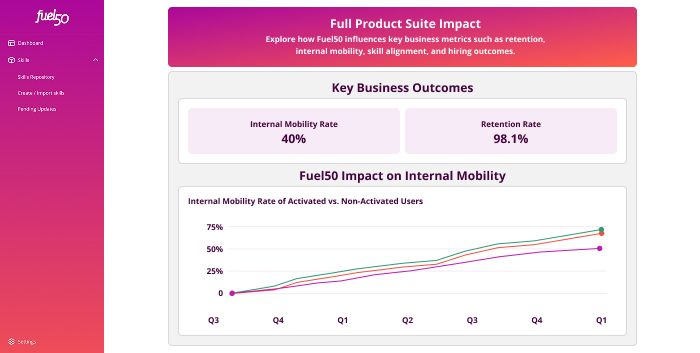
What it does: Fuel50 is a career development and internal mobility platform with a skills taxonomy, career journeys, and workforce planning.
Key strengths:
- Strong career pathing and journeys
- Skill Inventory, Skill Harmonization, and AI-recommended skills
- Well-liked support and a single view of skills, mobility, and planning
Limitations: SuccessFactors integration errors can pause data flow (Maisy H., Enterprise, June 24, 2026). It’s “not a plug-and-play solution” and needs upfront skills-architecture investment.
Implementation and integration: About 6 months to implement (G2), with 43 integrations listed.
Customer evidence: “It supports personalised development, internal mobility, and workforce planning in a single platform … Fuel50 requires a meaningful upfront investment … The platform is powerful, but not a plug-and-play solution.” (Sarah B., Head of People Experience, Enterprise, March 13, 2026, G2).
4. Eightfold
Best for: Enterprises whose primary problem is recruiting, with internal mobility as a secondary use.
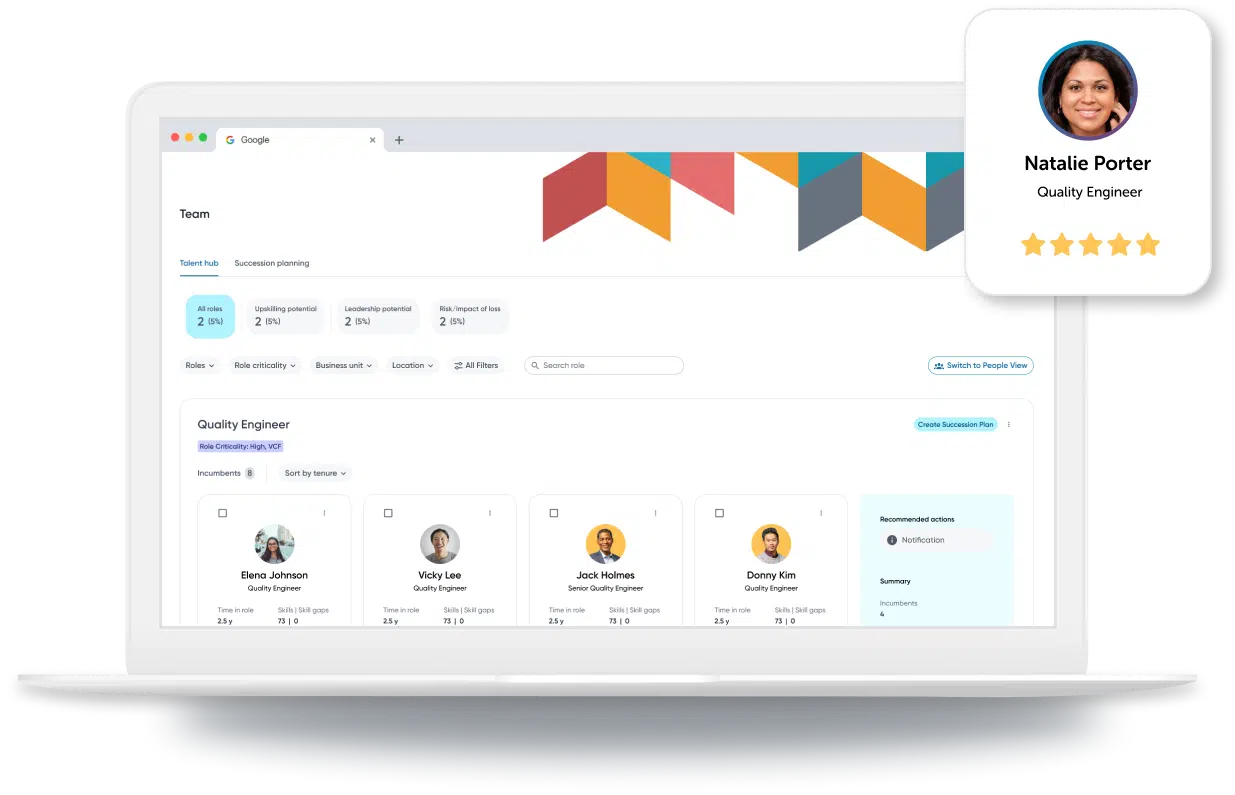
What it does: Eightfold is a talent intelligence platform for recruiting, with skills matching that extends into internal mobility.
Key strengths:
- Intuitive UI and match-score ranking
- Skills mapping that supports internal mobility
- A consolidated recruiting hub with strong integrations
Limitations: Reviews skew recruiting-first. Users report occasional lag and integration issues, plus slow or inaccurate support tickets (Stephanie B., Enterprise, November 5, 2025). There’s no native learning loop.
Implementation and integration: About 5 months to implement (G2), with SAP and applicant tracking system (ATS) integrations noted.
Customer evidence: “I love how Eightfold AI seamlessly maps skills to employees … I appreciate how it solves internal mobility by using skills.” (Vikram B., Enterprise, January 19, 2026, G2).
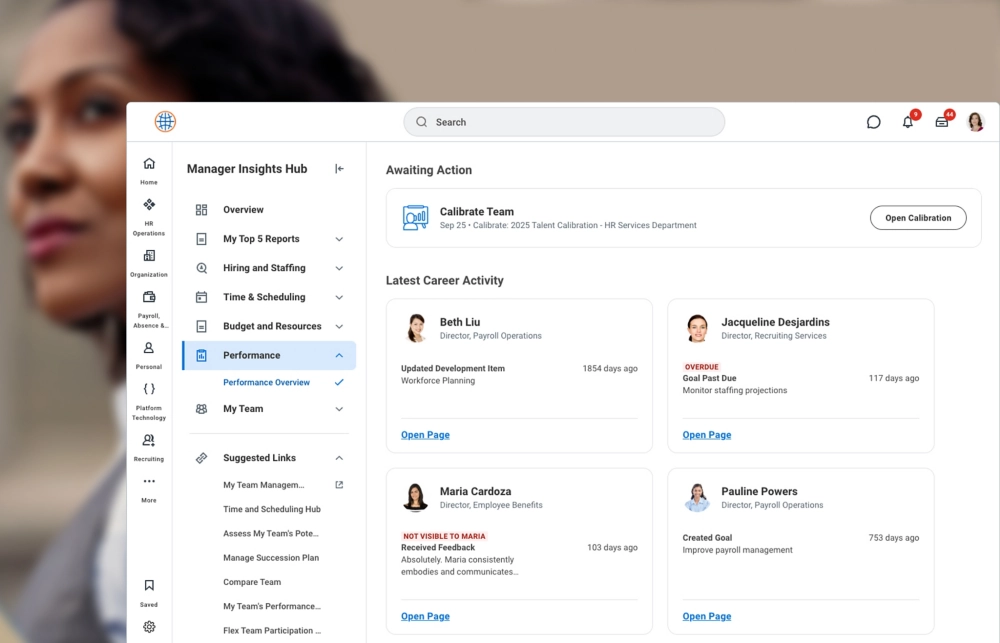
5. Workday
Best for: Organizations standardized on Workday HCM that want internal mobility inside their system of record.
What it does: Workday is an HCM suite with talent and mobility modules, including Skills Cloud and Talent Marketplace, layered on core HR.
Key strengths:
- A single source of truth for HR data
- Broad talent-lifecycle coverage in one portal
- Seamless module integration across compensation and position management
Limitations: Skills features are capture-first and updated manually, not continuous intelligence. Navigation is clunky and click-heavy, and mobility depth is secondary to core HCM.
Implementation and integration: About 6 months to implement (G2). Talent modules are native to the ecosystem but carry added cost and configuration.
Customer evidence: “Covers everything within the HR/Talent lifecycle stack … Extremely difficult to navigate. The portal also often has bugs and is laggy.” (Wye Kit T., Associate, Enterprise, June 5, 2026, G2).
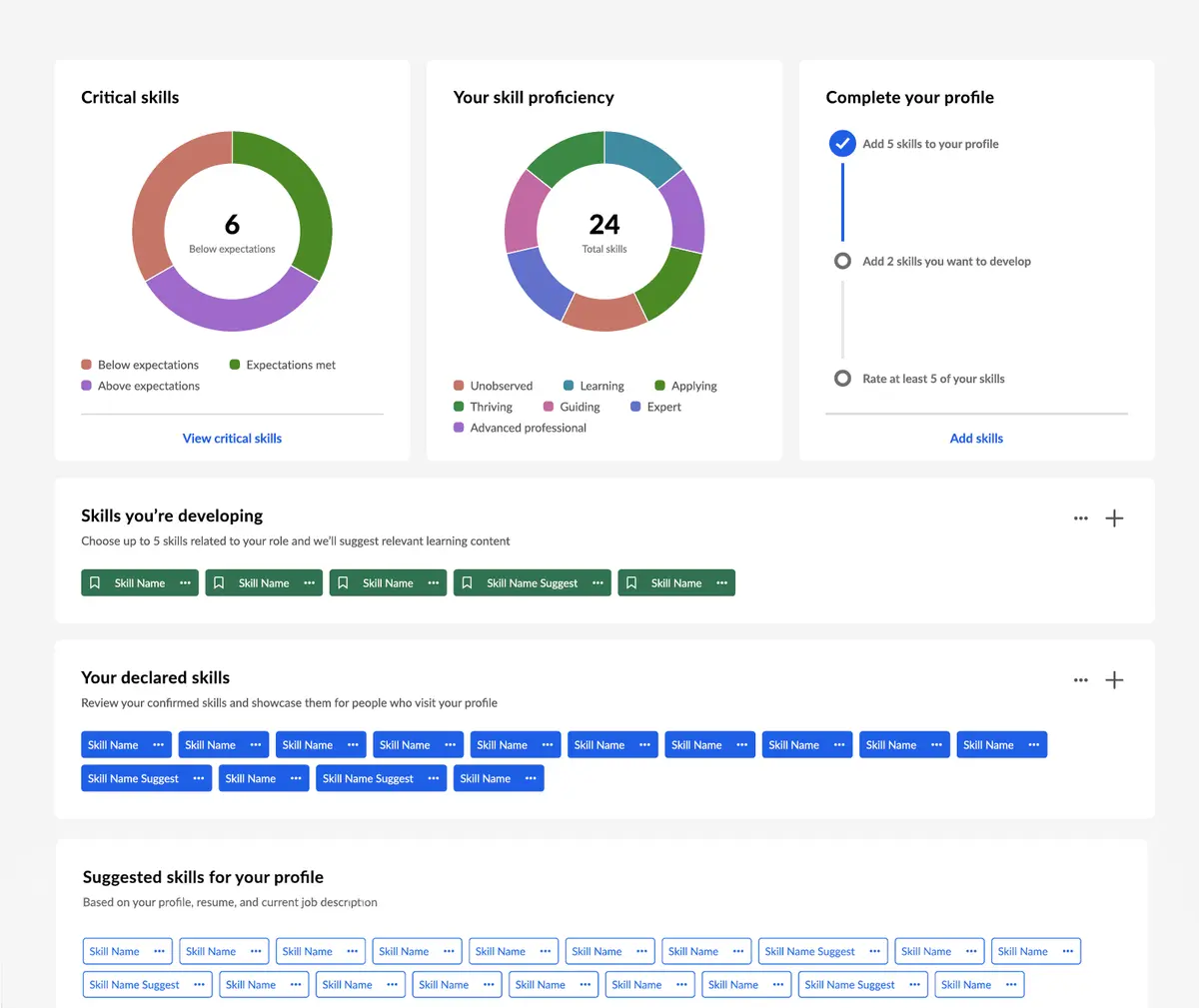
6. Cornerstone
Best for: Enterprises that want compliance-grade learning with skills visibility attached.
What it does: Cornerstone Learning is an LMS with learning paths and some skills and mobility features.
Key strengths:
- Centralizes training and compliance tracking
- Highly customizable, role-based learning paths
- Scalable curriculum management with skills visibility for leaders
Limitations: The UI is outdated and click-heavy, custom reporting is limited, and support can be slow. Skills are treated as learning tags, not workforce intelligence.
Implementation and integration: About 7 months to implement (G2), integrating with core HR systems.
Customer evidence: “Cornerstone Learning isn’t as modern as newer LMS systems … The system is so complex that it makes it difficult to find the tools we need.” (Jessica C., Training Coordinator, Mid-Market, May 5, 2026, G2).
7. Phenom
Best for: Talent-acquisition-led teams extending into internal mobility and career management.
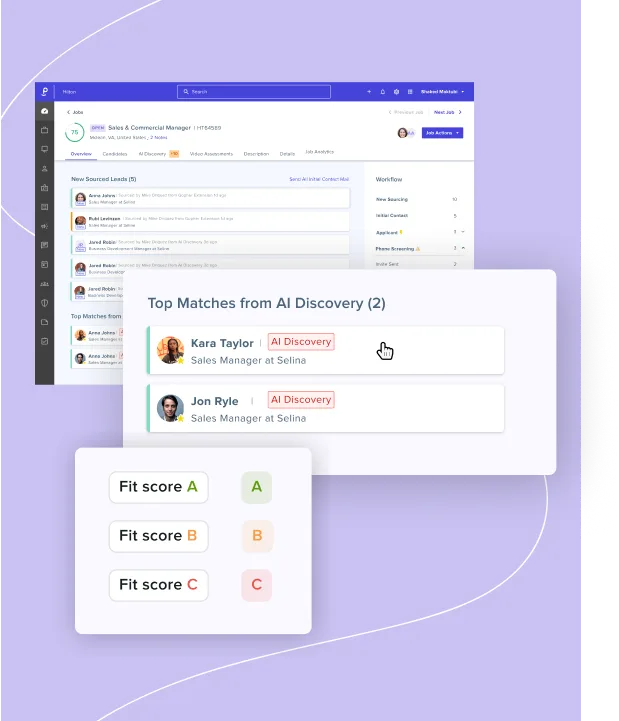
What it does: Phenom is a talent experience platform, recruiting-first, with career management and internal mobility modules.
Key strengths:
- Automates recruiting and admin work
- Intuitive UI with AI-driven matching (FitScore, AI Discovery)
- Candidate texting and automated nurturing
Limitations: Reviews center on recruiting; career management is a smaller category on the profile. AI matching needs manual tuning, and integration can create friction.
Implementation and integration: About 7 months to implement (G2).
Customer evidence: “I like using Phenom Applied AI for FitScore and AI Discovery because it really helps us find the right fit for candidates … I think the actual matching could be a little bit better.” (Erica F., Enterprise, March 12, 2026, G2).
8. Degreed
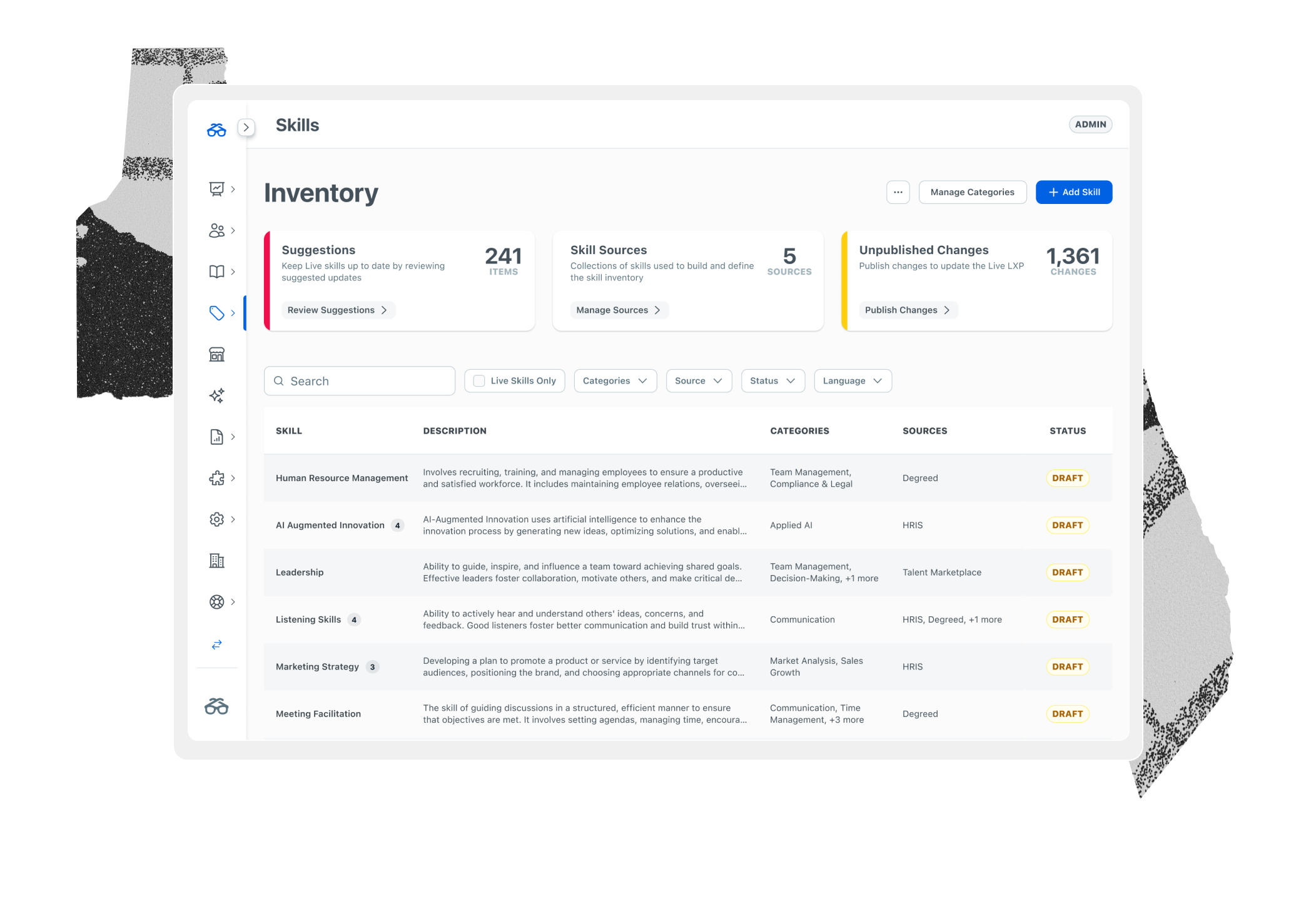
Best for: Enterprises building a skills-forward learning culture across many content sources.
What it does: Degreed is an LXP with talent-marketplace features that aggregates internal and external learning around skills.
Key strengths:
- Aggregates multi-provider content in one system
- Enables a skills-based organization approach
- Values formal, informal, and social learning, with badges and sharing
Limitations: Search and content discovery are weak. Because it’s “not a LMS,” management and reporting are limited, and HRIS integration gaps remain.
Implementation and integration: About 5 months to implement (G2).
Customer evidence: “how my organization can connect multiple content providers into a single system … since it is not a LMS some of the management capabilities (the M in LMS) are limited or non-existent.” (Jason B., Lead Learning Systems Specialist, Enterprise, June 13, 2019, G2).
Which platform fits which problem
| Scenario | Recommended platform | Why |
| You already run learning and need skills to drive development and mobility | Docebo | Connects skills intelligence to learning and measures capability gains |
| You want a mature, employee-facing gig and project marketplace fast | Gloat | Proven, employee-first talent marketplace |
| Personalized career pathing and a common skills language are the priority | Fuel50 | Deep career journeys and skills harmonization |
| Recruiting is the primary problem, mobility secondary | Eightfold or Phenom | Talent-acquisition-first with skills matching |
| You’re standardized on Workday and want mobility in your system of record | Workday | Native to your HCM, with basic mobility |
| You need compliance-grade learning with skills visibility | Cornerstone | Customizable, scalable LMS |
| You want a skills-forward learning culture across many content sources | Degreed | Content aggregation and skills-based learning |
Frequently asked questions
What’s the difference between an internal mobility platform and an internal job board?
A job board just posts openings and waits for applications. An internal mobility platform matches people by verified skills and connects each match to development.
Which platforms combine skills intelligence, learning and internal talent mobility?
Docebo’s talent development approach is the native combination of all three. Standalone marketplaces and HCM suites cover only part of that loop.
Should we buy an internal mobility platform or build a marketplace ourselves?
Building rarely maintains skills freshness or the learning connection. Buying gets you continuous, inferred skills and a maintained integration layer far faster.
How does Docebo compare with Workday for internal mobility?
Workday captures skills manually inside the system of record. Docebo infers them continuously from real work and connects the gaps directly to learning.
What are the best alternatives to Gloat for internal mobility?
Fuel50, Eightfold, and Docebo are the strongest alternatives. Choose by your primary problem: career pathing, recruiting, or the skills-to-learning loop.
How long does an internal mobility platform take to implement?
Roughly 4 to 7 months, based on G2 self-reported data. Timelines are driven mostly by skills-taxonomy mapping and integrations.
What’s the shortlist, and why Docebo belongs on it
To shortlist, start from your primary problem and your existing stack, not a feature list. Then, during demos, test two things directly: how fresh the skills data stays, and whether a detected gap actually triggers learning.
That second test is where most platforms stop. Docebo connects continuously inferred skills to learning and measures real capability gains, not just matches. That’s why it belongs on your shortlist.
Take a tour of the platform today and put the skills-to-learning loop through its paces.